
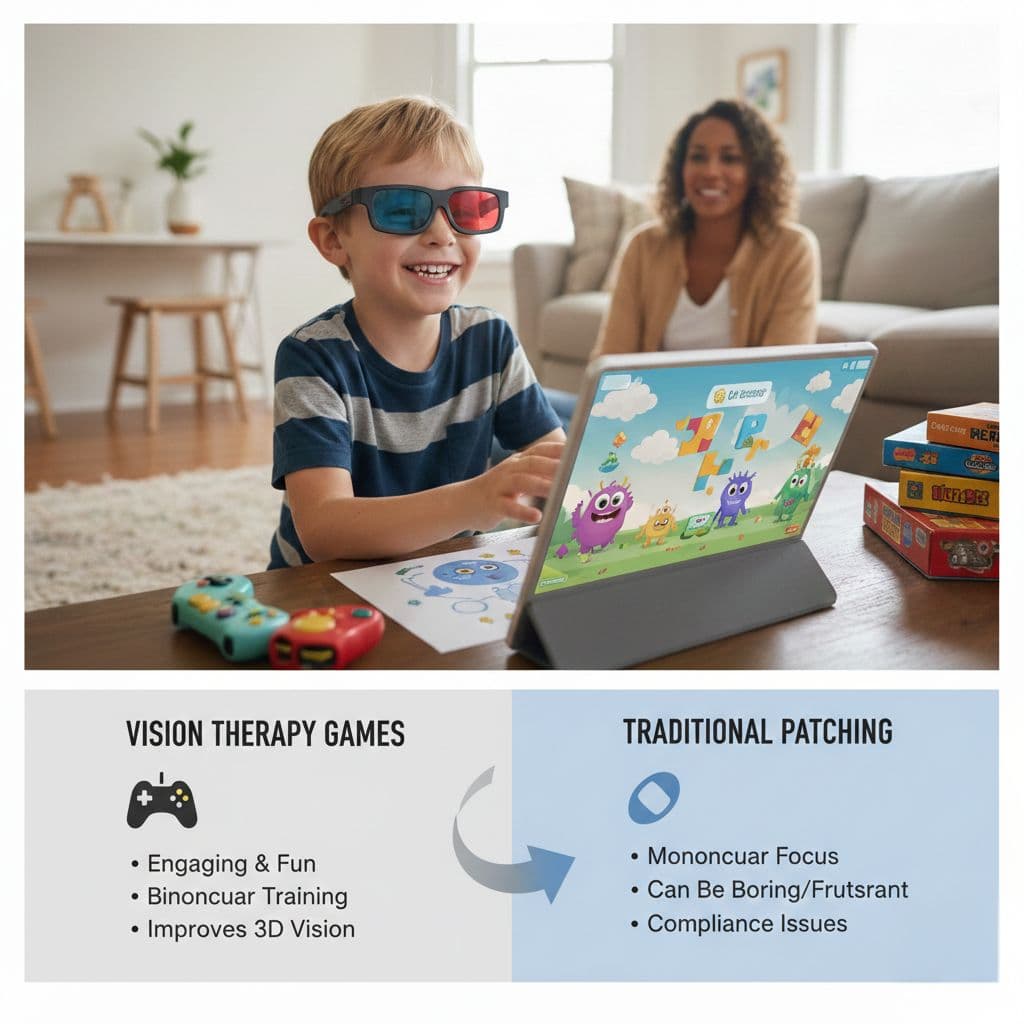
When you receive a medical diagnosis for your child, you’re suddenly faced with a series of choices. For us, hearing the word amblyopia, or “lazy eye,” immediately led to the standard recommendation: occlusion therapy, better known as patching. The concept is simple cover the strong eye to force the weaker eye to work. But for our family, the reality of patching felt complex, emotionally fraught, and incomplete. After researching the alternatives, we made a conscious and deliberate choice to pursue a different path: vision therapy games. This wasn’t a decision we made lightly. It was a choice between a traditional method that focuses on one eye and a modern approach that trains the brain. Here’s exactly why we chose engaging, game-based vision therapy over patching for our child’s amblyopia.
The Diagnosis and the Standard Prescription: Patching
Understanding our choice starts with understanding the problem. Amblyopia isn’t truly an “eye” problem; it’s a neurodevelopmental condition. The brain, for various reasons like eye misalignment (strabismus) or a major difference in prescription (anisometropia), learns to favor one eye and suppress the visual input from the other. The “lazy” eye can see, but the brain ignores it.
The goal of patching is to reverse this suppression. By blocking the “good” eye, it forces the brain to engage with the weaker eye, strengthening its neural pathways. Decades of use have shown that it can improve visual acuity (the ability to see clearly on an eye chart).
However, as we looked down the path of daily patching, we saw significant drawbacks:
- The Emotional and Social Toll: We pictured our son at school, on the playground, feeling different and visually impaired. The potential for teasing, self-consciousness, and social withdrawal was a major concern.
- The Practical Struggle: Patching compromises depth perception and peripheral vision, making sports, reading, and even navigating a room more difficult and frustrating. This often leads to a daily battle between parent and child, with compliance rates notoriously low.
- The Incomplete Solution: Our biggest reservation was scientific. Patching is a monocular treatment it works on one eye at a time. It can make the weaker eye stronger, but it doesn’t inherently teach the two eyes how to work together as a team. The root of the problem, the lack of binocular vision, wasn’t being directly addressed.
Discovering the Alternative: Vision Therapy Games
Our research led us to developmental optometry and the concept of treating amblyopia as a brain problem, not just an eye problem. The goal of this approach isn’t just to improve sight in one eye but to retrain the brain to fuse the images from both eyes into a single, 3D picture. This is true binocular vision, and the key to unlocking it lies in neuroplasticity the brain’s amazing ability to rewire itself.
Modern vision therapy leverages neuroplasticity through prescribed, software-based activities that feel like video games. This was the turning point for us. Instead of a treatment that felt like a punishment, we found one that was engaging, fun, and designed to fix the core issue.
Programs developed by vision science companies like Bynocs use a method called dichoptic therapy. The child wears special glasses and plays a game where different elements are shown to each eye. For example, the right eye sees the car, and the left eye sees the road. To win the game, the brain has no choice but to stop suppressing the weaker eye and start using both eyes as a team. It’s a targeted workout that makes the brain build the binocular skills it’s missing.
A Head-to-Head Comparison: Why Games Won for Us
Eye Patching (Occlusion Therapy)
- Primary Goal: To improve visual acuity in the weak eye.
- Method: A monocular approach that treats one eye in isolation.
- Core Principle: Forces the use of the weaker eye.
- Child’s Experience: Often feels frustrating, uncomfortable, and isolating.
- Compliance: Frequently a source of conflict between parents and children.
- Skill Development: Primarily strengthens central vision.
- End Result: Can lead to two strong eyes that still fail to work together as a team.
Vision Therapy Games (Dichoptic Therapy)
- Primary Goal: To restore binocular vision and 3D perception.
- Method: A binocular approach that forces both eyes to work together.
- Core Principle: Retrains the brain using neuroplasticity.
- Child’s Experience: Engaging, fun, and empowering.
- Compliance: High due to the interactive, game-based format.
- Skill Development: Improves 3D vision, tracking, and focusing.
- End Result: Results in two eyes that work together efficiently and achieve true stereoscopic vision.
This comparison revealed that vision therapy wasn’t just a more pleasant alternative; it was a more comprehensive one. It aimed for a higher goal: not just getting our son to see better with his weaker eye, but to achieve true stereoscopic vision for a lifetime.
Our Family’s Experience and the Results
Once we made our choice, the first step was figuring out how to explain ‘brain training’ to our child and get him excited. From there, our focus shifted to transforming treatment into a positive experience by making vision therapy a fun part of our daily routine. This required a different level of parental engagement than patching would have, fundamentally changing how much daily involvement was needed from us as parents.
The results went beyond just a good attitude. At his optometry check-ups, the data proved our decision was the right one. Not only was the visual acuity in his amblyopic eye improving, but also his tests for stereopsis (3D vision) were showing remarkable gains. He was catching balls with more confidence, his reading was smoother, and for the first time, his brain was learning to see the world in three dimensions.
Conclusion
Choosing a treatment for your child is a personal decision, and patching is still a valid tool in vision care. But for our family, the choice was clear. We chose vision therapy games over patching because we wanted a solution that addressed the root cause of amblyopia the brain’s inability to use both eyes together. We chose an approach that motivated and empowered our child instead of frustrating him. We opted for a treatment that leveraged cutting-edge neuroscience to build lasting binocular vision, not just better monocular sight. By choosing games, we didn’t just avoid a daily struggle; we invested in a more complete and foundational cure for his vision.
Frequently Asked Questions (FAQs)
1. Is vision therapy always better than patching?
Vision therapy is often more comprehensive because it targets binocular vision (depth perception). However, the “best” approach depends on the specific diagnosis. In cases of very deep amblyopia, a doctor might recommend a short course of patching to “prime” the eye before starting game-based therapy. Always consult a developmental optometrist.
2. Is vision therapy backed by scientific evidence?
Yes. A growing body of peer-reviewed research in major ophthalmology and optometry journals supports the effectiveness of Perceptual Learning and Dichoptic Therapy. Studies show that these methods can improve visual acuity and stereopsis effectively, often with better retention than patching.
3. How much does vision therapy cost compared to patching?
This is the main barrier for many. Patching is very cheap (the cost of band-aids). Vision therapy is a financial investment involving professional fees, software subscriptions, and equipment. However, many parents view it as a tuition cost for a lifetime of better vision. Insurance coverage varies by region and provider.
4. Can adults benefit from vision therapy games for amblyopia?
Absolutely. The old belief that you cannot treat lazy eye after age 7 is outdated. Thanks to neuroplasticity, adult brains can learn and change. While adults may require a longer treatment duration than children, they often have higher motivation and can achieve significant improvements in 3D vision and clarity.
5. Does looking at screens hurt the eyes during therapy?
This is a common worry. However, the software used in vision therapy is specific and controlled. It is not passive consumption like watching TV; it is active visual engagement. The activities are timed to prevent digital eye strain, and the benefits of the neural training far outweigh the screen time exposure.
6. How do I find a qualified provider?
You need to look beyond a standard eye exam. Look for a Developmental Optometrist or a Behavioral Optometrist (often denoted by the credentials FCOVD). These doctors specialize in neuro-optometry and binocular vision dysfunction.