
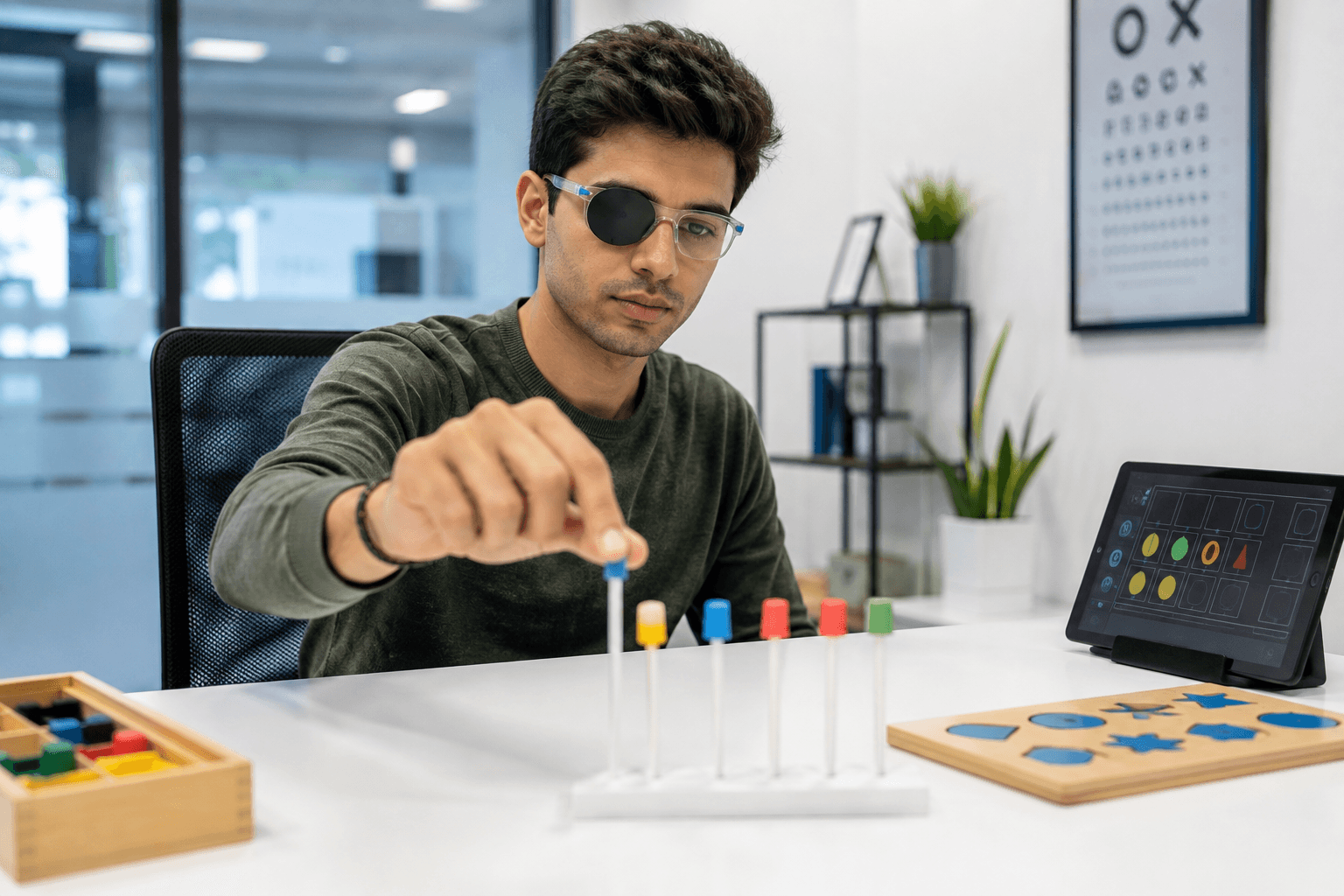
For generations, adults living with Amblyopia commonly known as lazy eye have carried a discouraging piece of advice given to them during their youth. They were told that once they passed the age of seven or eight, their visual system was permanently set. The window of opportunity had closed, and they would simply have to adapt to living with poor depth perception, visual fatigue, and uneven coordination.
Fortunately, as we navigate 2026, clinical vision science has dismantled this outdated narrative. A profound shift in neurological research has proven that the adult visual system is remarkably resilient and capable of change. Adults do not have to accept poor binocular vision as a permanent limitation, nor do they need to look toward invasive structural procedures.
Today, advanced visual solutions are helping adults retrain their brains and restore balanced visual function. To understand how these changes fit into the wider landscape of modern, non-invasive eye care, read our complete guide on how lazy eye can be treated without surgery in 2026.
The Science of Adult Neuroplasticity: How the Adult Brain Learns to See
To understand why a non-surgical eye treatment is highly effective for adults, we must look at how the brain processes visual information. Lazy eye is not a structural problem with the physical eye itself. Instead, it is a neurological coordination issue rooted in the brain’s visual cortex.
When the brain receives mismatched visual data from the two eyes, it struggles to merge them into a single, cohesive image. To prevent confusing double vision or physical strain, the visual cortex initiates binocular suppression. This means the brain actively ignores the signals coming from the weaker eye, relying almost entirely on the dominant eye. Over years of neglect, the neural pathways connecting the suppressed eye to the brain grow weak and dormant.
For decades, science assumed that these pathways could not be rebuilt after early childhood. However, modern research is built on the foundation of neuroplasticity. Neuroplasticity is the brain’s lifetime ability to reorganize its neural connections, learn new skills, and adapt to fresh sensory experiences. Just as an adult can learn a new language, the adult visual cortex can learn to process dormant sensory signals.
[Mismatched Visual Inputs] —> [Brain’s Visual Cortex] —> [Active Suppression of Weak Eye]
|
v (Stimulated by Neuroplasticity)
[Rebuilt Neural Pathways]
By providing targeted, active visual stimulation, we can encourage the brain to wake up these dormant neural pathways. In fact, adult patients often progress incredibly well in vision therapy. Because adults possess high levels of cognitive focus, attention to detail, and internal motivation, they can engage with therapies in a highly disciplined manner, driving efficient neural adaptation.
Through structured, AI-powered vision therapy, adults can systematically rebuild these connections, teaching the brain to accept inputs from both eyes simultaneously and restoring healthy, comfortable visual processing.
Beyond the Patch: Why Traditional Methods Left Adults Behind
When traditional lazy eye treatments were designed, they relied almost exclusively on monocular patching. This process involves taping or placing an adhesive patch over the dominant eye for several hours a day. The goal is to isolate the weaker eye, forcing it to work harder and strengthen its visual acuity.
While patching has helped many children over the decades, it is highly impractical and structurally limited for adults. For a working professional, wearing an eye patch in meetings, while driving, or during daily social interactions is awkward, highly conspicuous, and physically exhausting.
More importantly, patching fails to address the root of the problem. Patching is a monocular therapy, meaning it treats only one eye at a time. It does nothing to teach both eyes how to work together as a coordinated unit. Because patching ignores the brain’s need for binocular fusion, many patients experience a rapid regression in their visual gains once they stop wearing the patch.
Modern science has shifted toward a superior, binocular approach known as dichoptic training. During a session of digital vision therapy, the patient views specialized screens or wears specific glasses where both eyes are fully active at the same time.
The software presents different visual elements to each eye, reducing the contrast and brightness of the image shown to the stronger eye while keeping the image shown to the weaker eye vivid and bright. To complete the visual tasks, the brain is forced to process information from both eyes simultaneously, actively breaking down binocular suppression.
This contrast-balanced approach teaches the brain to coordinate both eyes as a unified team, leading to more stable, natural, and long-lasting visual improvements. Explore this scientific evolution further in our analysis of whether patching is still the best lazy eye treatment or if digital therapies are better in 2026.
Gamified Visual Exercises: Making Adult Therapy Non-Invasive and Engaging
One of the greatest barriers to successful vision therapy has always been the nature of the exercises themselves. Historically, adult eye exercises consisted of repetitive, tedious tasks like tracking physical strings, staring at static cards, or tracing manual patterns. For busy adults managing careers and personal lives, these exercises quickly felt like an inconvenient burden.
The integration of gamification and artificial intelligence has completely transformed this experience. By embedding clinical-grade visual exercises into high-quality, interactive video games, eye care has evolved from a boring task into an enjoyable, rewarding daily routine.
====================================================================
THE POWER OF GAME-BASED THERAPY
====================================================================
* High Engagement: Immersive challenges replace tedious, manual drills.
* Smart Adaptation: AI constantly recalibrates difficulty based on progress.
* Zero Burden: Short, enjoyable daily sessions fit busy adult lifestyles.
====================================================================
During a session of game-based vision therapy, the adult patient plays specially designed digital games that require tracking targets, solving spatial puzzles, and reacting to visual changes. While the patient is fully engaged in the play, sophisticated AI algorithms operate in the background.
The AI system tracks performance metrics in real-time, including response speed, alignment accuracy, and eye-teaming efficiency. It then dynamically scales the contrast levels, motion speed, and difficulty to match the user’s progress. If a session is too easy, the AI gently raises the challenge to continue driving neuroplasticity. If the user experiences eye strain, the system immediately adjusts to ensure a comfortable experience.
This tailored approach ensures that every minute spent in therapy is optimized for your brain’s exact needs. Learn more about the mechanics behind this technology in our article on how AI games help in lazy eye treatment without making therapy feel like a burden.
Why Adult Treatment Attempts Fail (And How to Avoid the Pitfalls)
While the science supporting adult visual recovery is strong, some individuals still struggle to achieve the results they desire. Understanding why adult therapy attempts sometimes fail is key to choosing the right path forward.
Typically, setbacks in adult vision therapy can be traced back to three main factors:
- Inconsistent Compliance: Adults lead incredibly busy lives. When a therapy program is inconvenient, requires travel to a clinic multiple times a week, or involves frustrating, manual drills, compliance drops. Consistent, daily stimulation is required to build new pathways; without it, the brain defaults to its old patterns.
- Outdated Monocular Methods: Trying to treat adult amblyopia with patching or monocular exercises alone rarely yields permanent results. Unless the brain is trained in binocular coordination, the suppression of the weaker eye will return.
- Lack of Personalization: A generic eye exercise routine cannot account for the unique differences in every individual’s visual system. Without real-time adjustments and progress tracking, the therapy can quickly become ineffective or physically exhausting.
To avoid these common pitfalls, adults require an engaging, highly personalized, and binocular approach. By choosing a sophisticated, home-based eye therapy that adapts dynamically to your lifestyle, you can easily maintain consistent habits and achieve lasting visual success.
Read our diagnostic guide on why lazy eye treatment fails for some patients: compliance, wrong timing, or wrong method to learn how to set yourself up for success.
Integrating Modern Vision Therapy into a Busy Adult Routine
For adults managing demanding careers, families, and personal commitments, the biggest hurdle to vision care is often scheduling. Traditional therapies that require regular, in-person clinic visits simply do not align with a modern lifestyle. This is where advanced software-based solutions provide a practical breakthrough.
Rather than relying on invasive methods or tedious physical exercises, modern software-based platforms like Bynocs (BYNOCS) allow you to engage in clinical-grade training directly from your personal computer. By combining contrast-balanced games with sophisticated software, adults can actively retrain their visual cortex from the comfort of their home or office.
This specialized approach is designed to fit effortlessly into your day. A typical session of home-based eye therapy requires only a brief, 20-to-30-minute daily commitment—easily completed during a lunch break or as part of a morning routine. By using specialized glasses and playing adaptive, scientifically calibrated games, you can target the root neurological causes of coordination issues without disrupting your busy schedule.
Conclusion & Next Steps
If you are an adult living with a lazy eye, it is time to leave the myths of the past behind. In 2026, we know that your brain is highly capable of change, adaptation, and growth. You are not too old, and your visual system is not locked in place.
By shifting our focus toward the brain and embracing modern, non-invasive digital treatments, we can rebuild weak visual pathways comfortably and effectively. Clearer vision, enhanced depth perception, and a more comfortable visual experience are well within your reach.
Take the first step toward a clearer future. Reach out to a vision specialist today to explore how a personalized Bynocs therapy program can help you achieve healthy, balanced vision from the comfort of home.
Frequently Asked Questions (FAQs)
Is it too late to fix lazy eye in adulthood?
No, it is absolutely not too late. Modern research on neuroplasticity has proven that the adult brain is highly capable of restructuring its neural connections. While progress may require structured dedication, adults of all ages can successfully retrain their brains to process inputs from a lazy eye.
Can adults use eye patches to cure a lazy eye?
While eye patches can be used, they are generally not the most effective approach for adults. Patching is a monocular treatment that does not teach the eyes to work together as a team. Modern dichoptic digital therapies, which engage both eyes simultaneously, offer faster, more stable, and highly functional binocular results.
How long does non-surgical adult lazy eye treatment take?
The timeline varies depending on the individual’s visual system and consistency of therapy. Generally, patients notice improvements in eye coordination and depth perception within a few weeks of consistent, daily 20-to-30-minute sessions of game-based therapy, with full programs typically spanning a few months.
Can computer glasses or surgery solve the underlying brain-eye coordination issue?
No. Standard glasses simply correct refractive errors, and surgery physically aligns the structural eye muscles. Neither method teaches the brain’s visual cortex how to coordinate the eyes as a team. Software-based vision therapy is specifically designed to address and solve this underlying neurological coordination issue.