
Eat your carrots so you can see in the dark!
If you grew up hearing this, you are not alone. It is perhaps the most pervasive myth in vision health. While carrots are good for you, the idea that simply eating a specific vegetable will fix a complex vision problem is misleading.
When it comes to amblyopia (lazy eye), the stakes are higher. Parents often ask, “Can I fix my child’s lazy eye with diet?”
The honest answer is: No, food alone cannot fix a lazy eye. A salad cannot unturn a crossed eye (strabismus), nor can a smoothie change the shape of an eye that causes refractive error.
However, that is not the whole story.
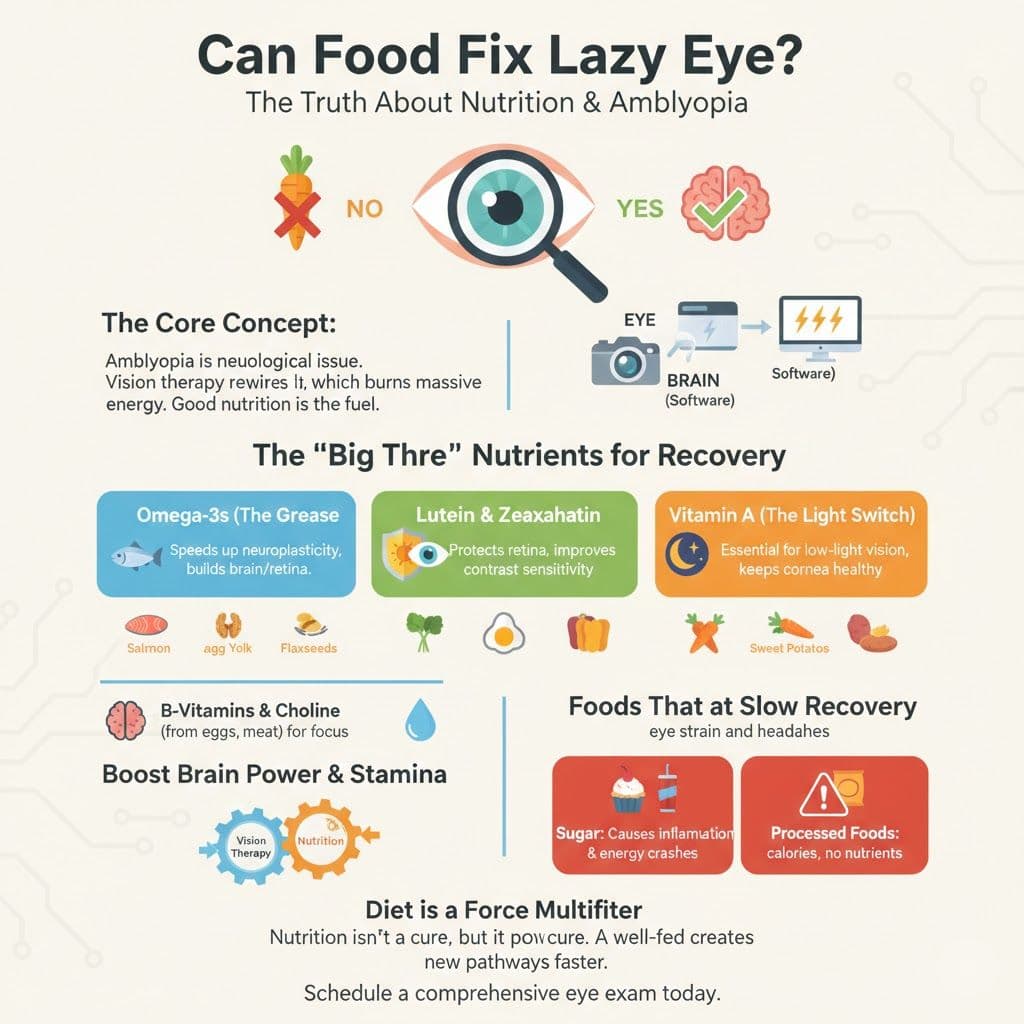
Amblyopia is fundamentally a neurological condition. It is a problem with how the brain processes information. And the brain is the most energy-demanding organ in the body. While food cannot replace glasses or vision therapy, proper nutrition acts as the “fertilizer” for the brain. It provides the raw materials needed to build new neural pathways and repair the visual system.
The Teen Brain Connection: Whether you are a parent of a young child or a teenager trying to optimize your own treatment, giving your body the right tools is essential for recovery. Understanding the unique challenges and adaptations of the visual system in this age group is vital, which is why we created a comprehensive guide: A Complete Guide to Understanding Lazy Eye (Amblyopia) for Teenagers.
The Biology: Why Your Eyes Are Only as Good as Your Diet
To understand the role of nutrition, we have to look at the anatomy of the visual system. Think of the eye as the hardware (the camera) and the brain as the software (the computer).
Hardware vs. Software
The retina at the back of your eye is lined with millions of photoreceptors (rods and cones). These cells are responsible for capturing light and converting it into electrical signals. This process is metabolically expensive meaning it burns a lot of fuel. Once that signal travels down the optic nerve, the brain takes over. In Amblyopia, the brain is actively working to suppress a confusing image while simultaneously trying to rewire itself during treatment. This requires a massive amount of oxygen, glucose, and specific fatty acids.
Oxidative Stress and the Eye
Because the eyes are constantly exposed to light and oxygen, they are highly susceptible to Oxidative Stress. This is “biological rusting” caused by free radicals. If the diet lacks antioxidants, the delicate cells of the retina and the brain can become inflamed or sluggish, slowing down the progress of vision therapy.
Root Causes: To understand why the brain needs so much energy to fix this issue, you have to understand the specific “disconnect” causing the lazy eye in the first place. Before fueling the recovery process, it helps to know the precise challenge, so learn more about the biological root of this disconnect: What Causes a Lazy Eye? A Clear and Simple Breakdown of the Main Risk Factors and Root Problems.
The “Big Three” Nutrients for Amblyopia Recovery
If you are looking to create a “Vision Recovery Diet,” these are your three non-negotiable pillars.
1. Omega-3 Fatty Acids (DHA and EPA)
If there is a “superfood” for the lazy eye, this is it.
- The Science: DHA (docosahexaenoic acid) is a structural fat. It makes up a massive percentage of the retina’s photoreceptors and the gray matter in the brain. It keeps the cell membranes flexible, allowing electrical signals to transmit quickly.
- Why it matters for amblyopia: Vision therapy is about speed and connection. Omega-3s essentially “grease the gears” of neuroplasticity, helping the brain form new connections faster.
- Where to get it: Fatty fish (salmon, mackerel, sardines), walnuts, flaxseeds, and high-quality fish oil or algae supplements.
2. Lutein and Zeaxanthin (The Internal Sunglasses)
These are powerful antioxidants known as carotenoids.
- The Science: Unlike other nutrients that disperse throughout the body, lutein and zeaxanthin accumulate specifically in the macula, the center of the retina responsible for detailed vision. They form a yellow pigment that acts as “internal sunglasses,” filtering out harmful blue light and protecting the retina.
- Why it matters for Amblyopia: Patients with lazy eyes often struggle with Contrast Sensitivity (seeing objects against a similar background). High levels of Lutein have been shown to improve contrast sensitivity and reduce glare recovery time.
- Where to get it: Dark leafy greens (Kale, Spinach, Collard Greens), Egg Yolks, and brightly colored peppers.
3. Vitamin A and Beta-Carotene
This is where the carrot myth comes from, and it does have truth to it.
- The Science: Vitamin A is essential for the production of Rhodopsin, a protein in the eye that helps you see in low-light conditions. It also maintains the health of the cornea (the front surface of the eye).
- Why it matters for Amblyopia: A deficiency in Vitamin A leads to night blindness and dry eyes, both of which add “noise” to the visual signal the brain receives. We want that signal to be as clear as possible.
- Where to get it: Carrots, Sweet Potatoes, Pumpkin, and Cantaloupe.
Boosting Neuroplasticity: Brain Food for Vision Therapy
Recovering from Amblyopia isn’t just about eye health; it’s about brain endurance.
B-Vitamins and Choline
- Vitamin B12: Crucial for the health of the optic nerve. A deficiency can actually cause optic neuropathy (damage to the nerve).
- Choline: A precursor to Acetylcholine, a neurotransmitter that is vital for attention and focus. Since vision therapy requires intense concentration, Choline helps keep the brain “online.”
- Sources: Eggs, lean meats, broccoli.
Hydration and the Vitreous Humor
The eyeball is filled with a jelly-like substance called the Vitreous Humor, which is 99% water. Even mild dehydration can cause the vitreous to shrink slightly, leading to eye strain and headaches. For a child doing vision exercises, a headache is a guaranteed way to end the session early. Keeping them hydrated is the easiest way to improve stamina.
Parenting Tip: We know that getting a child to eat spinach or take fish oil can be just as hard as getting them to wear an eye patch. If the daily resistance around compliance is your biggest hurdle, or if you need tips on managing the daily struggles of treatment including mealtime battles check out our parent coaching guide: How can I support my child throughout the lazy eye treatment process?
The Enemies of Vision: Foods that Slow Recovery
Just as some foods fuel the brain, others act as sludge in the engine.
Sugar and Inflammation
High-sugar diets lead to systemic Inflammation. Inflammation is like static on a radio line it interferes with clear communication between neurons. Furthermore, blood sugar spikes are followed by crashes. If a child eats a high-sugar snack before vision therapy, their focus will likely crash halfway through the session.
- Swap: Instead of candy or juice, offer apple slices with peanut butter (fiber + protein) for sustained energy.
Processed Foods and “Empty Calories”
Processed foods are often stripped of nutrients and loaded with unhealthy fats. If your child fills up on empty calories, they aren’t getting the Zinc, Magnesium, and Vitamins needed for repair. It is a lost opportunity for healing.
Conclusion: Diet is a Force Multiplier
Nutrition is not a magic wand. You cannot eat your way out of a refractive error. But nutrition is a force multiplier.
A well-fed brain creates new neural pathways faster. A well-nourished retina sends cleaner signals. A hydrated body has more stamina for therapy.
You don’t need to overhaul your entire kitchen overnight. Start small. Add a fish oil supplement. Swap chips for carrots and hummus. Make a “Hulk Smoothie” with spinach hidden inside. Every nutrient is a building block for your child’s future vision.
Looking Ahead: Nutrition is a lifelong strategy. The goal isn’t just to complete the treatment phase, but to maintain and preserve that new vision for decades to come. To learn how to protect your vision long-term and what the post-treatment phase involves, read our guide on My child’s treatment is completed, how do we maintain the progress and keep their vision from regressing?
Frequently Asked Questions (FAQs)
Do vision supplements actually work for lazy eye?
Supplements can be very effective if there is a nutritional gap in the diet. A high-quality Omega-3 (Fish Oil) supplement is often recommended by developmental optometrists because it directly supports brain plasticity. However, supplements should never replace a balanced diet.
Can eating carrots really fix my eyesight?
No. Carrots are rich in Vitamin A, which is vital for eye health, but they cannot correct the neurological suppression of a lazy eye or change your prescription. They maintain the health of the eye hardware, but they don’t fix the software.
How much water should my child drink for eye health?
A general rule of thumb is their body weight (in pounds) divided by two, in ounces. So, a 60-lb child should aim for about 30 ounces of water a day. Proper hydration keeps the eye tissues plump and reduces fatigue.
Are there specific foods to avoid during vision therapy?
Try to minimize inflammatory foods like excessive sugar, soda, and highly processed snacks. These can cause “brain fog” and energy crashes, making the concentration required for vision exercises much more difficult.
Is a vegan diet safe for vision recovery?
Yes, but you must be mindful of Vitamin B12 and Omega-3s. Since these are primarily found in animal products (meat and fish), a child on a vegan diet should likely take an Algal Oil (plant-based Omega-3) supplement and a B12 supplement to ensure their nervous system has what it needs.
2. Breadcrumb Schema 3. FAQ Schema