
Take a deep breath. You did it.
After months (or perhaps years) of adhesive patches, daily eye drops, arguing over glasses, and driving to weekly vision therapy appointments, your doctor has given you the news: “We are done.”
Your child’s visual acuity has improved. The eye turn is gone or significantly reduced. They are catching balls, reading without headaches, and seeing the world in a way they never could before. This is a massive achievement, and you should take a moment to celebrate the dedication it took to get here.
But if you are like most parents, that celebration is quickly followed by a nagging question: “Is it over forever?”
The fear that the lazy eye will “slip back” or that the vision will regress is valid. The truth is, vision is a dynamic process, not a static trophy you put on a shelf. While the hard work of building the neural pathways is done, the work of maintaining them has just begun.
Maintenance isn’t about more patching; it is about integrating clear vision into daily life so the results stick.
This maintenance phase is especially critical for teenagers, whose visual demands (driving, studying for SATs) are increasing rapidly. For parents managing this transition with an adolescent, a dedicated resource like A Complete Guide to Understanding Lazy Eye (Amblyopia) for Teenagers offers age-specific insights.
Understanding Regression: Why Would Vision Go Back?
To prevent regression, you have to understand why it happens. It usually isn’t because the eye itself has changed, but because the brain has fallen back into old habits.
The “Use It or Lose It” Principle
We have talked a lot about Neuroplasticity the brain’s ability to rewire itself. This works both ways. Just as the brain learned to use the lazy eye, it can “unlearn” it if the path of least resistance becomes appealing again.
If the connection between the eyes is weak, and the child stops wearing their glasses or stops doing activities that require both eyes, the brain might say, “It’s too much effort to use that weaker eye. I’ll just go back to ignoring it.” This leads to a return of Suppression.
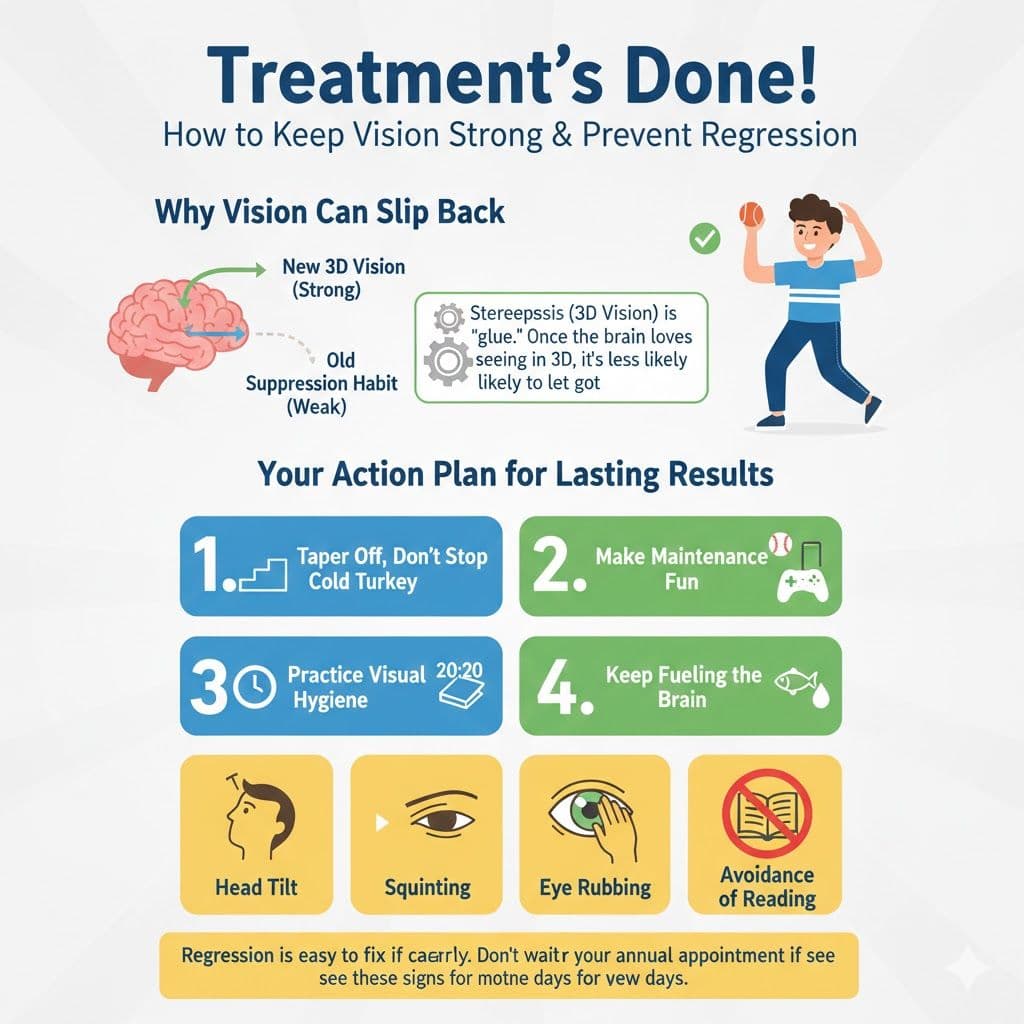
The “Glue” of Vision: Stereopsis
The biggest predictor of regression is whether or not the patient achieved Stereopsis (3D Depth Perception).
- Acuity vs. Function: Getting the lazy eye to see 20/20 on a chart is great, but it is not the whole story.
- The Glue: Stereopsis is the result of both eyes working perfectly together. Once the brain locks into seeing in 3D, it loves it. 3D vision provides so much information that the brain becomes reluctant to give it up. If your child achieved strong 3D vision, regression is much less likely. If they only improved acuity but still lack depth perception, the risk of regression is higher.
Regression often happens when the original root cause like a high prescription or a subtle muscle imbalance—isn’t managed correctly post-treatment. To refresh your memory on the biological triggers of your child’s condition, we recommend revisiting What Causes a Lazy Eye? A Clear and Simple Breakdown of the Main Risk Factors and Root Problems.
The “Weaning” Process: Don’t Stop Cold Turkey
One of the biggest mistakes parents make is stopping all treatment the day the doctor says “you’re done.”
Imagine your child had a broken leg. When the cast comes off, you don’t immediately send them to run a marathon. You do physical therapy to strengthen the atrophied muscles. The visual system is the same.
The Tapering Schedule
A good Developmental Optometrist will never discharge a patient abruptly. We use a Tapering Schedule to ensure the brain remains stable as we remove support.
- Phase 1 (Weekly to Bi-Weekly): Instead of therapy every week, we move to every two weeks.
- Phase 2 (Monthly Check-ins): We monitor stability over a month.
- Phase 3 (The 3-Month Gap): If vision holds stable for three months without active therapy, the brain has likely “owned” the new skill.
Patching Taper
If you were patching for 2 hours a day, do not go to 0 hours tomorrow.
- Week 1: Reduce to 1 hour/day.
- Week 2: Reduce to 30 mins/day.
- Week 3: Patch 30 mins every other day.
- Week 4: Stop patching.
Home Maintenance Exercises
Your doctor may prescribe a “maintenance kit.” This usually involves doing one or two simple binocular activities once a week just to “ping” the brain and remind it to use both eyes.
- The Brock String: A simple string with beads used to check if both eyes are turning in (converging) correctly.
- Lifesaver Cards: Transparent cards that require 3D vision to clear the image.
Lifestyle Integration: Making Vision Fun
The goal of maintenance is to stop doing “therapy” and start living life. The best maintenance exercises are real-world activities that require depth perception.
“Real World” Vision Therapy
Encourage your child to engage in sports and hobbies that demand Visuo-Motor Integration (hand-eye coordination).
- Ball Sports: Tennis, Ping Pong, Baseball, and Badminton are excellent. They require the child to judge the speed and distance of a moving object in 3D space.
- Playground Play: Climbing monkey bars or jungle gyms builds spatial awareness.
- Video Games: Yes, really! Action-oriented video games (played in moderation) or VR games require rapid visual processing. If your child plays these games with both eyes open (and glasses on), they are effectively maintaining their vision.
Visual Hygiene for School and Work
School is the enemy of visual recovery if habits are poor. Staring at a screen or book for hours can cause Visual Stress, which triggers the brain to shut down the weaker eye to save energy.
- The 20-20-20 Rule: Every 20 minutes, look at something 20 feet away for 20 seconds. This relaxes the focusing system.
- Harmon Distance: Ensure your child isn’t burying their nose in their book. They should keep reading material at elbow-distance.
You’ve spent months being your child’s “Vision Coach.” Now, your role shifts to monitoring their habits without nagging. To find tips on maintaining a vision-friendly home environment and guidance on How can I support my child throughout the lazy eye treatment process?, revisit our foundational guide.
Fueling the Eyes for the Long Haul
Just because the therapy appointments have stopped doesn’t mean the biological needs of the eye have changed.
Nutrient Maintenance
The visual system is still an energy-hog. To maintain the high-speed connection between the eye and the brain, you need to continue providing the raw materials for nerve health.
- Omega-3s: Continue with fish oil supplements or a diet rich in fatty fish. This maintains the flexibility of the cell membranes in the retina.
- Hydration: Dehydration leads to fatigue. A tired brain is a suppressing brain. Ensure they are drinking water throughout the school day.
Diet remains a powerful tool for preserving eye health as your child grows. For a complete understanding of how to protect their hard-won vision, review our detailed analysis on Can Food Improve Vision? The Truth About Diet, Nutrition, and Lazy Eye.
Warning Signs: When to Call the Doctor
Ideally, you will only see your eye doctor for annual check-ups. However, you should be vigilant for Red Flags that indicate regression is starting.
The Golden Rule: Regression is easy to fix if caught in the first month. It is hard to fix if you wait a year.
Watch for these signs:
- The Head Tilt: If your child starts tilting their head to watch TV again, they might be trying to align their eyes mechanically because the brain is struggling.
- Squinting: Closing one eye in bright sunlight or while reading is a classic sign of suppression.
- Rubbing Eyes: Frequent rubbing during homework indicates visual fatigue.
- Clumsiness: If they start knocking over water glasses or tripping on curbs, their depth perception may be slipping.
- Reading Avoidance: If a child who learned to like reading suddenly hates it again, check their vision.
Action Plan: If you see these signs for more than a few days in a row, do not wait for your annual appointment. Call your developmental optometrist and ask for a “acuity check” or a “maintenance check.” A brief 2-week booster of therapy is often all it takes to get back on track.
Conclusion: Vision for Life
Completing treatment for a lazy eye is one of the best gifts you can give your child. You haven’t just improved their eyesight; you have improved their ability to learn, play, and interact with the world.
Regression is possible, but it is not inevitable. By weaning off treatment slowly, encouraging active play, maintaining good nutrition, and watching for red flags, you can ensure that the results last a lifetime.
So go ahead and throw that celebration party. Burn the eye patches (safely!). You earned it.
Frequently Asked Questions (FAQs)
How often should my child have eye exams after treatment?
Typically, we recommend an exam 3 months after treatment ends, then 6 months later, and then annually after that. However, strictly follow your doctor’s specific recall schedule.
Will my child need to wear glasses forever?
In many cases, yes. If the root cause of the lazy eye was a refractive error (like high farsightedness), the glasses are what provide the clear image to the brain. Removing the glasses removes the clear image, which will almost certainly cause the lazy eye to return. Think of glasses as a prosthetic that allows the system to function.
Can we stop the eye drops (Atropine) immediately?
Follow your doctor’s advice, but usually, Atropine is tapered. Stopping abruptly can cause a “rebound” effect where the treated eye struggles to focus.
What if the vision regresses? Do we have to start over?
Usually, no. You rarely start from square one. The neural pathways are there; they just got “dusty.” A short course of “booster” therapy (often just 4-6 weeks) is usually enough to wake the system back up and restore clear vision.
Can adults regress too?
Yes. If you treated a lazy eye as a teen or adult, the same rules apply. Visual hygiene (breaks from screens) and general health are vital to maintaining your results.