
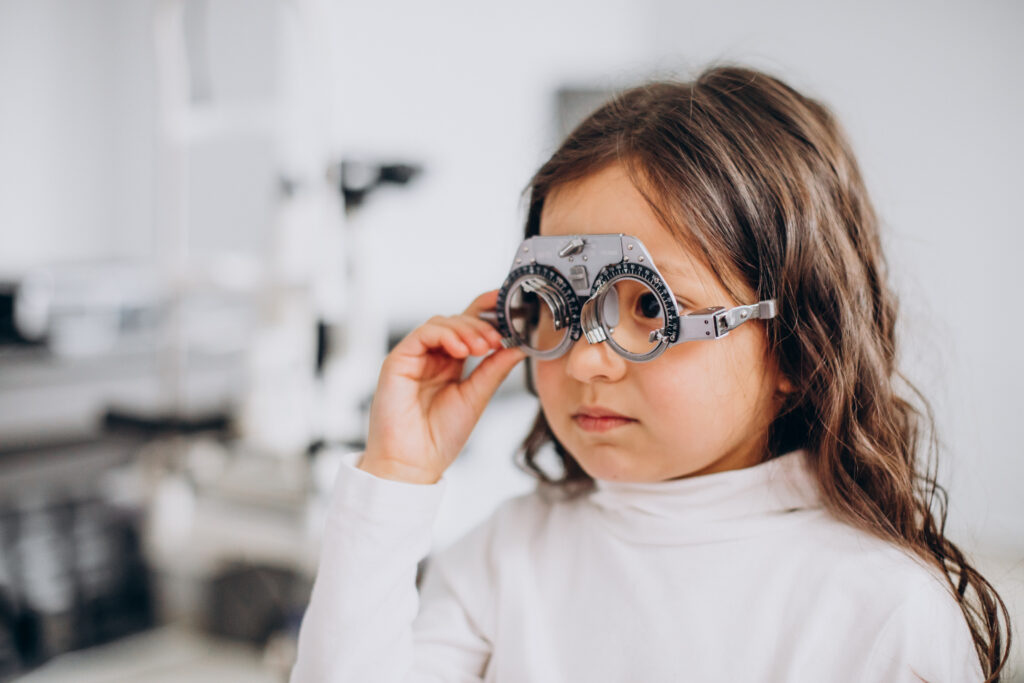
Sarah noticed something unusual during her daughter’s third birthday party. While other children eagerly reached for falling balloons, Emma stood back, squinting and tilting her head. A week later, a comprehensive pediatric eye exam revealed moderate amblyopia in her left eye. Thanks to early detection, Emma began treatment immediately. Today, her vision has improved dramatically.
This story repeats itself in eye care offices across the country. Unfortunately, many other stories don’t end as well. One in four school-age children has an undiagnosed vision problem affecting their daily life. These hidden conditions silently impact learning, development, and future opportunities.
Regular pediatric eye exams serve as the first and most effective line of defense against preventable vision loss. These comprehensive evaluations catch problems early when treatment works best. Many conditions, including lazy eye, respond dramatically better to early treatment discovered through routine professional exams.
Why Pediatric Eye Exams Matter More Than You Think
Many parents assume their children would complain if something was wrong with their vision. Unfortunately, this assumption leads to countless missed diagnoses every year.
The Hidden Nature of Childhood Vision Problems
Children don’t know what “normal” vision looks like. A child who has always seen blurry letters on a whiteboard assumes everyone experiences the same thing. They have no frame of reference for comparison.
This creates a dangerous situation. Children rarely complain about vision problems because they don’t recognize anything is wrong. Instead, they develop compensatory behaviors. They might sit closer to screens, tilt their heads, or avoid reading altogether. Parents and teachers often misinterpret these behaviors as preference rather than necessity.
Consider this striking statistic: approximately 80% of classroom learning is visual. Reading, watching demonstrations, copying from boards, and recognizing faces all depend on healthy vision. When vision problems go undetected, the educational consequences compound over time.
Vision Problems Don’t Just Affect Sight
The impact of childhood vision problems extends far beyond blurry images:
Academic Performance
Children with untreated vision issues struggle with reading fluency and comprehension. They lose their place frequently, skip words, and avoid reading whenever possible. Teachers may assume these children lack motivation or ability when vision is actually the underlying problem.
Social Development
Recognizing facial expressions, making eye contact, and participating in group activities all require good vision. Children with visual difficulties may appear withdrawn or socially awkward.
Physical Coordination
Sports, playground activities, and basic motor skills depend on visual input. Poor depth perception affects everything from catching balls to navigating stairs safely.
Long-Term Implications
Untreated childhood vision problems can limit career options, affect driving ability, and reduce quality of life permanently. Many conditions that are easily treatable in childhood become much more difficult or impossible to correct in adulthood.
What Happens During a Comprehensive Pediatric Eye Exam?
Many parents hesitate to schedule eye exams because they’re unsure what to expect. Understanding the process helps reduce anxiety for both parents and children.
Age-Appropriate Testing Methods
Eye care professionals use different techniques depending on your child’s age and developmental stage:
Infants (6-12 Months)
Doctors test pupil response to light and observe how babies fixate on and follow objects. The red reflex test checks for abnormalities inside the eye. Photo screening technology can detect refractive errors even before babies can communicate.
Toddlers (1-3 Years)
Picture recognition tests replace letter charts. Doctors observe tracking abilities and eye alignment. Retinoscopy objectively measures prescription needs without requiring verbal responses from the child.
Preschoolers (3-5 Years)
Shape matching games and LEA symbols (pictures instead of letters) assess visual acuity. Children at this age can often participate more actively in testing. This critical window catches many cases of amblyopia and other treatable conditions.
School-Age Children (6+ Years)
Standard letter charts become appropriate. Comprehensive refraction determines precise prescription needs. Doctors thoroughly evaluate binocular vision, focusing ability, and eye health.
Beyond the Eye Chart: What Doctors Really Look For
A comprehensive pediatric eye exam evaluates much more than how small of letters your child can read:
- Eye alignment and coordination: Do both eyes work together properly?
- Focusing ability: Can your child shift focus between near and distant objects smoothly?
- Depth perception: Does your child accurately judge distances?
- Eye health: Are internal structures developing normally?
- Color vision: Can your child distinguish colors accurately?
- Peripheral vision: Does your child see adequately to the sides?
These evaluations require specialized equipment and professional training that school screenings simply cannot provide.
Making the Experience Positive for Children
Modern pediatric eye care offices create welcoming environments for young patients:
- Child-friendly decorations and waiting areas
- Age-appropriate explanations of each test
- Patience with children who need extra time
- Gentle approaches to anxious patients
Most comprehensive pediatric exams take 30-60 minutes. Preparing your child by explaining that the doctor will “look at their eyes with special lights and fun games” helps reduce nervousness.
The Recommended Eye Exam Schedule Every Parent Should Know
Knowing when to schedule exams eliminates guesswork and ensures your child receives timely care.
Critical Exam Milestones
First Exam: 6-12 Months of Age
Your baby’s first eye exam might seem early, but this timing serves crucial purposes. Doctors assess basic visual development and detect congenital conditions that require immediate attention. This exam establishes baseline measurements for future comparison.
The InfantSEE program offers free first eye exams for qualifying families. Participating optometrists provide comprehensive assessments regardless of family income or insurance status.
Second Exam: Age 3 Years
This exam is absolutely critical for detecting amblyopia and other conditions that respond best to early treatment. By age three, children can participate in more detailed testing. Doctors identify refractive errors that will affect learning before school begins.
Third Exam: Before Kindergarten (Ages 5-6)
Visual readiness for school requires evaluation before academic demands intensify. Doctors identify conditions affecting reading readiness. Many school districts require documentation of vision examinations before enrollment.
Ongoing Exams: Annually Throughout Childhood
Children’s eyes change rapidly during growth years. Annual exams monitor visual development, update prescriptions as needed, and catch emerging problems early. Consistent care maintains optimal visual function throughout childhood and adolescence.
Why This Schedule Matters for Long-Term Vision
Visual development follows specific timelines. Certain conditions can only be effectively treated during narrow windows of opportunity. Missing these windows can result in permanent vision impairment that could have been prevented.
This examination schedule aligns with the best ages for treating conditions like lazy eye, when the brain remains most responsive to intervention. Early exams combined with timely treatment produce the best possible outcomes.
Common Vision Problems Detected Through Early Exams
Understanding what exams can catch helps parents appreciate their importance.
Refractive Errors
Myopia (Nearsightedness)
Children with myopia see near objects clearly but struggle with distance vision. This condition is increasing dramatically among children, partly due to increased screen time and reduced outdoor activity. Early detection allows for correction and potential myopia control interventions.
Hyperopia (Farsightedness)
Farsighted children struggle with close work like reading and writing. They may experience eye strain, headaches, and fatigue during schoolwork. This condition often goes undetected because children can partially compensate.
Astigmatism
Astigmatism causes blurred vision at all distances. Children may experience headaches and eye strain. Corrective lenses provide clear, comfortable vision.
Binocular Vision Disorders
Amblyopia (Lazy Eye)
This condition represents the most common cause of childhood vision loss. One eye develops weaker connections with the brain. When detected early, amblyopia is highly treatable. However, treatment becomes progressively more difficult with age.
Strabismus (Crossed Eyes)
Eye misalignment can cause the brain to ignore one eye’s input. Left untreated, strabismus often leads to amblyopia. Early intervention improves both appearance and function.
Convergence Insufficiency
Children with this condition struggle to coordinate their eyes for near tasks. Reading becomes difficult and exhausting. Vision therapy effectively treats most cases.
Eye Health Conditions
Comprehensive exams also detect serious conditions including:
- Congenital cataracts
- Pediatric glaucoma
- Retinoblastoma (childhood eye cancer)
- Blocked tear ducts
- Ptosis (drooping eyelid)
Early detection of these conditions can be sight-saving or even life-saving.
The Critical Connection: Early Detection and Treatment Success
Timing dramatically affects treatment outcomes for most childhood vision conditions. Amblyopia treatment, for example, works best when started before age seven. Treatment success rates decrease significantly with each year of delay.
Conditions like amblyopia demonstrate why timing matters so much. Learn about the best age to treat lazy eye and why early detection through regular exams is essential for optimal outcomes.
Warning Signs Your Child Needs an Eye Exam Now
While scheduled exams remain important, certain signs warrant immediate professional attention.
Behavioral Warning Signs
Watch for these behaviors that may indicate vision problems:
- Squinting or closing one eye to see better
- Excessive eye rubbing, especially during visual tasks
- Tilting or turning the head to use one eye
- Sitting unusually close to screens or holding books very near
- Losing place frequently while reading
- Using a finger to track words on pages
- Avoiding reading, homework, or close work activities
- Covering one eye while reading or watching television
Physical Symptoms to Watch
Physical signs that require professional evaluation include:
- Frequent headaches, especially after school
- Eye pain, burning, or itching
- Red, watery, or irritated eyes
- Unusual sensitivity to light
- One eye turning inward, outward, or in different directions
- White reflection visible in pupil (requires urgent evaluation)
- Drooping eyelid affecting vision
- Excessive tearing or discharge
Academic and Developmental Red Flags
These signs often indicate undetected vision problems:
- Declining grades without clear explanation
- Difficulty with reading comprehension
- Poor hand-eye coordination for age
- Reluctance to participate in sports or physical activities
- Attention and focus problems during visual tasks
- Frustration with homework or avoidance behaviors
- Complaints that words “move around” on pages
Many students struggle academically due to undiagnosed vision issues that proper examination would reveal. Additionally, teenagers increasingly report eye fatigue that often traces back to uncorrected or undetected vision problems.
School Vision Screenings vs. Comprehensive Eye Exams
Many parents believe that passing school screenings means their child’s vision is healthy. This dangerous misconception delays countless diagnoses.
What School Screenings Actually Test
School vision screenings provide basic, limited assessments:
- Distance visual acuity only (usually the 20/20 line)
- Pass/fail format with minimal sensitivity
- Conducted by school nurses or volunteers without eye care training
- Completed in under five minutes per student
- Limited equipment and testing conditions
What School Screenings Miss
These quick assessments fail to detect numerous conditions:
- Farsightedness (hyperopia)
- Eye coordination and alignment problems
- Focusing disorders affecting near work
- Mild to moderate amblyopia
- Color vision deficiencies
- Eye health abnormalities
- Conditions affecting reading specifically
The Dangerous False Confidence
Research reveals alarming statistics about screening accuracy. School vision screenings miss up to 75% of vision problems in children. A “passing” result provides false reassurance while conditions worsen undetected.
Many treatable conditions progress silently between annual screenings. Time-sensitive treatment windows close while parents believe everything is fine. The cost of missed diagnosis far exceeds the investment in comprehensive professional care.
Protecting Vision in the Digital Age
Today’s children face visual challenges previous generations never encountered. Understanding these modern risks helps parents protect developing eyes.
The Screen Time Epidemic
Children today spend unprecedented hours on digital devices. Average daily screen exposure for school-age children now exceeds six hours. For teenagers, this number rises even higher.
Digital device use affects developing eyes in several ways:
- Extended near focus strains eye muscles
- Reduced blink rates cause dry, irritated eyes
- Blue light exposure may affect sleep patterns
- Near work is associated with myopia progression
Digital Eye Strain in Children
Many children experience symptoms they cannot articulate:
- Tired, heavy-feeling eyes
- Headaches during or after device use
- Blurred vision that comes and goes
- Difficulty switching focus between distances
- Neck and shoulder tension
Children may not recognize these symptoms as abnormal. They often push through discomfort, potentially worsening underlying problems.
Balancing Technology and Eye Health
Practical strategies protect children’s vision in digital environments:
The 20-20-20 Rule
Every 20 minutes, look at something 20 feet away for 20 seconds. Teaching children this habit reduces eye strain significantly.
Appropriate Screen Distance
Devices should be held at arm’s length, not close to the face. Computer screens should be slightly below eye level.
Outdoor Time
Research consistently shows outdoor play reduces myopia progression. Natural light exposure supports healthy visual development. Aim for at least one to two hours outside daily.
Regular Breaks
Encourage frequent breaks from all screens. Physical activity provides natural visual breaks.
Understanding how much screen time is appropriate for children’s vision helps parents establish healthy boundaries. Extended screen time can mask or exacerbate underlying conditions. If you’re concerned about your child’s vision development, understanding the optimal treatment windows for conditions like lazy eye becomes even more important in our digital world.
Teenagers report higher rates of eye fatigue than adults largely due to intensive digital device use combined with developing visual systems. Regular exams become even more critical for monitoring digital-age eye health.
Finding the Right Pediatric Eye Care Provider
Choosing the right professional ensures your child receives appropriate care.
Types of Eye Care Professionals
Pediatric Ophthalmologist
A medical doctor (MD or DO) specializing in children’s eye health. Can perform surgery if needed. Best choice for complex conditions or known eye diseases.
Pediatric Optometrist
A doctor of optometry (OD) with specialized training in children’s vision. Provides comprehensive exams and treats many conditions. Often more accessible than pediatric ophthalmologists.
General Optometrist
Can examine children but may lack specialized pediatric training and equipment. Appropriate for older children with straightforward needs.
What to Look for in a Provider
When selecting a pediatric eye care provider, consider:
- Experience with children your child’s age
- Child-friendly office environment and staff
- Clear communication with both parents and children
- Availability for follow-up appointments
- Acceptance of your insurance plan
- Convenient location and hours
Questions to Ask Before Scheduling
Prepare by asking:
- What age range do you typically see?
- How do you handle anxious or uncooperative children?
- What testing equipment do you use for young patients?
- How long does a comprehensive exam typically take?
- Do you offer appointments outside school hours?
Investing in Your Child’s Visual Future
Protecting your child’s vision starts with understanding one fundamental truth. Pediatric eye exams are essential healthcare, not optional extras. These comprehensive evaluations catch problems early when treatment produces the best outcomes.
Remember the critical exam milestones:
- First exam between 6-12 months
- Second exam at age 3
- Third exam before kindergarten
- Annual exams throughout childhood
Don’t wait for obvious symptoms or rely solely on school screenings. Children rarely recognize or report vision problems on their own. Proactive professional care provides the only reliable protection against preventable vision loss.
The investment in regular pediatric eye exams pays dividends throughout your child’s entire life. Academic success, social confidence, physical coordination, and future opportunities all depend on healthy visual development during these critical years.
Remember, conditions like amblyopia respond dramatically better to early treatment. If your child has never had a comprehensive eye exam, or if you’ve noticed any warning signs, now is the time to act. Learn more about the best age to treat lazy eye and why early intervention matters so much.
Frequently Asked Questions
At what age should a child have their first eye exam?
The American Optometric Association recommends a child’s first comprehensive eye exam between 6-12 months of age. This early examination detects congenital conditions and establishes baseline visual development. Programs like InfantSEE offer free first exams for qualifying infants regardless of family income or insurance status.
How often should children get eye exams?
Children should have comprehensive exams at 6-12 months, age 3, before kindergarten (ages 5-6), and annually thereafter throughout childhood and adolescence. Children with diagnosed vision problems, family history of eye conditions, or other risk factors may need more frequent evaluations as recommended by their eye care provider.
Can vision problems cause learning difficulties in school?
Yes, absolutely. Undiagnosed vision problems represent a leading cause of academic struggles in children. Since approximately 80% of classroom learning is visual, conditions affecting sight significantly impact reading, comprehension, attention, and overall academic performance.
Are pediatric eye exams covered by insurance?
Most vision insurance plans and many health insurance plans cover pediatric eye exams. Under the Affordable Care Act, children’s vision care is classified as an essential health benefit. Coverage varies by plan, so contact your insurance provider for specific details about your benefits and any applicable copays.
My child passed their school vision screening. Do they still need an eye exam?
Yes, comprehensive exams remain essential. School screenings detect only about 25% of vision problems in children. They test basic distance vision but miss many conditions affecting learning, development, and eye health. A passing screening result does not guarantee healthy vision. Professional examination by a qualified eye care provider remains necessary.
How do I know if my child has vision problems?
Watch for warning signs including squinting, excessive eye rubbing, head tilting, sitting too close to screens, losing place while reading, avoiding close work, frequent headaches, and academic struggles. However, many children with vision problems show no obvious symptoms. Regular professional exams remain the only reliable way to ensure healthy visual development.