
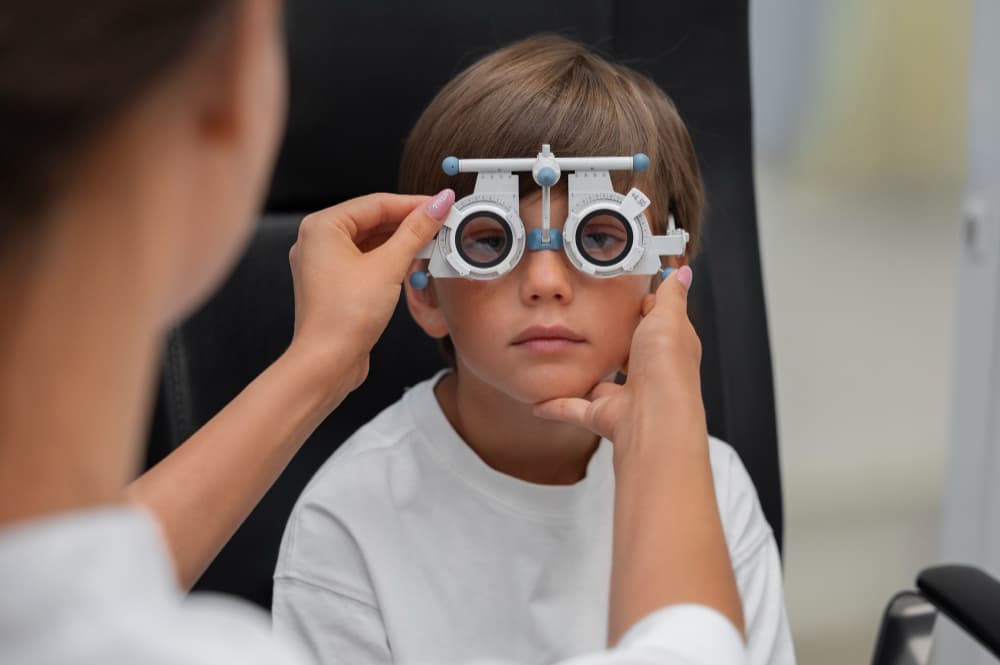
Every year, millions of bright, capable children struggle in the classroom. When a child falls behind in reading, fails to complete assignments, or acts out during class, parents and educators naturally look for an explanation. Often, the immediate assumption is a learning disability, such as dyslexia, or an attention disorder, like ADHD.
However, a highly common and highly treatable culprit is frequently overlooked: an undiagnosed vision problem.
Because up to 80% of all learning is visually acquired, the visual system is the primary gateway through which a child receives academic information. To understand the profound, systemic impact this has on a child, we highly recommend starting with our comprehensive pillar guide: [Internal Link: How Vision Problems Affect Learning, Reading, and Daily Life in Children].
In this article, we will focus on the specific node of academic performance. We will explore the hidden ties between a child’s eyes and their grades, and provide you with the critical signs that indicate a vision problem is affecting your child’s school performance.
The 20/20 Illusion: Why School Screenings Miss the Mark
Why do children with vision problems pass school eye exams? School screenings use a standard Snellen eye chart to measure visual acuity (the ability to see letters clearly from 20 feet away). However, visual acuity is just one small entity within the complex visual system.
Reading and learning require a dynamic set of visual skills, including:
- Binocularity (Eye Teaming): The eyes working together to create a single 3D image.
- Accommodation (Eye Focusing): The ability to shift focus from a distant chalkboard to a close desk.
- Oculomotor Skills (Eye Tracking): The ability to move the eyes smoothly across a line of text.
A child can have perfect 20/20 distance vision but completely lack the eye-teaming and focusing skills required to read a textbook 14 inches from their face.
If your child has passed their school vision screening but is still struggling academically, discover the hidden reasons in our in-depth article: [Internal Link: Why Some Children Struggle to Focus Despite Normal Vision].
Academic Red Flags: How Vision Problems Disrupt Learning
When a child’s visual system is compromised, their ability to process information breaks down. Children do not know how to explain this; they assume everyone sees the text blurring or double. Therefore, parents must watch for these specific academic signs:
1. Skipping Lines and Losing Place While Reading
If your child frequently loses their place while reading aloud or skips over entire lines of text, this is a major red flag for an eye-tracking (oculomotor) dysfunction. When the eyes cannot smoothly track from left to right, they “jump” erratically, causing the child to lose their place. You may notice your child constantly relying on their finger or a ruler to guide their eyes across the page.
2. Poor Reading Comprehension
Does your child read a paragraph perfectly but have no idea what they just read? When a child suffers from a binocular vision issue, such as convergence insufficiency, they must expend an enormous amount of neurological energy simply to force their eyes to work together and keep the text clear. By the time they reach the end of the page, their brain has no cognitive energy left to comprehend or remember the story.
3. Reversing Letters and Words
While reversing “b” and “d” or reading “saw” instead of “was” is developmentally normal for very young children, it should resolve by the age of seven. If an older student continues to reverse letters or words, it is often a sign of a visual processing disorder, where the brain struggles to accurately interpret spatial orientation.
Physical Red Flags: The Toll on the Body
Vision problems do not just affect reading; they take a physical toll on a child’s body. Sustained visual stress leads to measurable physical discomfort. Look for these signs during homework time:
4. Frequent Headaches and Eye Rubbing
If your child consistently complains of headaches in the front of their head or around their temples shortly after school or during reading, this is a classic symptom of visual stress. Likewise, excessive eye rubbing is a child’s subconscious attempt to relieve muscle spasms inside the eye or soothe dryness.
Are tired, burning eyes making homework a daily battle? Learn more about the physical toll of near-point visual stress in our dedicated post: [Internal Link: Is Eye Fatigue Affecting Your Child’s Learning?]
5. Postural Changes and Head Tilting
Observe your child’s posture when they write or read. Do they cover one eye with their hand? Do they tilt their head at an extreme angle, or lay their head down on the desk while writing? Covering one eye is a coping mechanism to eliminate double vision. By shutting off one eye, the child temporarily relieves the brain from trying to merge two conflicting images.
6. Holding Material Too Close
If a child brings their tablet, book, or homework unusually close to their face (closer than the distance from their elbow to their middle knuckle), they may be dealing with undiagnosed myopia (nearsightedness) or struggling with an accommodation (focusing) spasm.
Behavioral Red Flags: The Emotional Impact of Visual Dysfunction
Perhaps the most heartbreaking signs that vision problems are affecting school performance are the behavioral changes. When learning causes physical discomfort and repeated failure, it severely damages a child’s self-esteem.
7. Avoidance and Procrastination
“I hate reading!” If your formerly curious child suddenly hates school or refuses to do their homework, consider vision. Human beings naturally avoid tasks that cause them pain or frustration. A child isn’t being “lazy” when they avoid reading; they are avoiding the eye strain, double vision, and fatigue associated with it.
8. Short Attention Span and Fidgeting
Visual dysfunctions are frequently misdiagnosed as ADHD. When a child cannot sustain focus on a page, they will inevitably look away, fidget in their seat, or talk to their neighbor. To an observer, this looks exactly like a lack of attention. However, it is often a lack of visual stamina.
Taking Action: What Parents Can Do Next
If you recognize multiple signs from this checklist in your child’s daily behavior, it is time to take proactive steps. Do not wait for the school to intervene, and do not assume your child will simply “outgrow” these struggles.
1. Schedule a Comprehensive Binocular Vision Exam
Bypass the standard pediatrician vision screening and book an appointment with a developmental optometrist. Request a comprehensive eye exam that specifically tests for binocularity, convergence, accommodation, and visual tracking.
2. Explore Optometric Vision Therapy
If the doctor diagnoses a functional vision problem, eyeglasses alone may not be enough. The gold standard for treating eye teaming and tracking disorders is Optometric Vision Therapy. This is a customized, doctor-supervised program that retrains the neurological connections between the brain and the eyes.
Historically, vision therapy involved basic charts and prisms. Today, however, doctors utilize cutting-edge technology to make treatment incredibly engaging for children. By using interactive, game-based software and virtual reality, therapists can improve a child’s visual skills faster and more effectively than ever before.
Want to know how video games and modern technology are curing visual dysfunctions? Read our exciting breakdown: [Internal Link: How Gamified Vision Therapy Works].
Conclusion: Setting Your Child Up for Success
Academic struggles should never be accepted as the “norm.” A child’s inability to focus, read fluently, or complete homework is a symptom of an underlying issue and very often, that issue is visual.
By familiarizing yourself with the academic, physical, and behavioral signs of visual dysfunction, you become your child’s greatest advocate. Identifying and treating vision problems early doesn’t just improve school performance; it restores a child’s confidence, relieves their physical discomfort, and reignites their natural love for learning.
Frequently Asked Questions (FAQs)
What are the signs of a vision problem in a student?
Common signs include skipping lines while reading, poor reading comprehension, reversing words or letters, frequent headaches, eye rubbing, covering one eye, and an active avoidance of homework or reading tasks.
Can vision problems be mistaken for ADHD or learning disabilities?
Yes. Conditions like Convergence Insufficiency (CI) make it incredibly difficult for a child to sustain focus on near tasks. The resulting behavior fidgeting, lack of focus, and task avoidance closely mimics ADHD, leading to frequent misdiagnoses.
Why does my child have reading problems if they have 20/20 vision?
20/20 vision only means a child can see letters clearly from 20 feet away. It does not measure eye tracking, focusing speed, or how the eyes work together as a team the exact skills required to read a book at a close distance.
How do you fix eye tracking problems in a child?
Eye tracking (oculomotor) problems are typically treated through Optometric Vision Therapy. This specialized therapy uses targeted exercises, often utilizing modern digital and gamified tools, to strengthen the neural pathways between the brain and the eye muscles, improving reading fluency.
When should I take my child for a comprehensive eye exam?
The American Optometric Association recommends a comprehensive eye exam at 6 months of age, 3 years of age, before starting first grade (around age 5 or 6), and annually thereafter, regardless of whether they have passed a school vision screening.