
Vision is learned, not switched on at birth. A newborn’s visual system is still under construction, and it builds itself over the following years based on the quality of the images it receives. Clear, balanced input from both eyes builds strong visual pathways. Unequal input builds uneven ones.
That is why timing matters so much. A vision problem corrected while the system is still forming responds far more readily than the same problem addressed years later. It is also why the most useful thing a parent can do is not to watch for complaint children rarely make them but to keep to scheduled eye checks. This forms one part of understanding unequal vision and how it shapes visual development.
Vision Is Built, Not Born
Newborns see very little detail. Over the first months and years, a child gradually develops sharper visual acuity, the ability to track moving objects, colour discrimination, and depth perception. None of this is automatic it happens because the visual cortex is receiving and processing images.
Visual development is the process by which the brain’s visual pathways organise themselves in response to the input each eye provides. When both eyes send clear, well-matched images, the brain learns to fuse them into a single three-dimensional picture. When one eye’s input is blurred or misaligned, those pathways develop unevenly.
The eyes, in other words, collect the information. The brain is what learns to see.
What the Critical Period Actually Means
You will often hear that childhood is a “critical period” for vision. The idea is sound, but it is frequently misunderstood in both directions.
Why the early years are the most responsive
Neuroplasticity the brain’s capacity to reorganise itself is at its highest while the visual system is still forming. That cuts both ways. A problem present during these years takes hold quickly, because the brain is actively adapting to whatever it receives. But corrections also take hold quickly, for exactly the same reason. This is why early amblyopia treatment tends to be shorter and more effective.
What it does not mean
It does not mean a hard deadline exists after which nothing can be done. The older view that treatment becomes pointless past a certain birthday has been substantially revised. Binocular approaches have shown meaningful improvement in older children, teenagers and adults. Later treatment is generally slower and demands more consistency but slower is a very different thing from impossible.
The practical takeaway sits between the two: act early because it is easier, not because later is hopeless.
What Can Go Wrong During Visual Development
Most childhood vision imbalances trace back to one of a small number of causes.
Unequal focusing power between the eyes
When one eye needs a noticeably different prescription from the other anisometropia it delivers a softer image while its partner delivers a sharp one. Because the child still sees well overall, nothing appears wrong to anyone watching. This is explored further in what happens when one eye sees less clearly than the other.
Eye misalignment
In strabismus, one eye points slightly inward or outward. The two eyes are looking at different things, so the images cannot be matched into one.
A physical obstruction to light
A congenital cataract, a drooping eyelid, or corneal clouding can block or scatter light reaching one eye. Even partial obstruction during the developmental years degrades that eye’s contribution.
How the brain responds
Faced with one clear image and one unreliable one, the brain does the efficient thing: it favours the clear signal. Sustained over months, that preference becomes visual suppression, where the brain actively reduces the weaker eye’s input. This is the mechanism behind amblyopia, and it is why the condition is treated as a brain-level issue rather than an eye-level one. The process is explained in why the brain sometimes prefers one eye over the other.
Why These Problems Rarely Announce Themselves
If you are wondering how something this significant could go unnoticed, there are three straightforward reasons.
The stronger eye compensates completely. With both eyes open, the child reads, plays, and moves normally. Nothing looks wrong because, functionally, very little is wrong yet.
Children cannot report what they have never experienced. A child whose right eye has always been blurred assumes that is simply what seeing is like. They are not hiding it they have no basis for comparison.
There are no alarm symptoms. No pain, no redness, no headaches in most cases. Nothing prompts a parent to book an appointment.
Missing an imbalance like this is not a lapse in attention. It is the nature of the condition, and it is precisely why scheduled eye checks exist rather than a wait-and-see approach.
Signs Parents Can Watch For
That said, some patterns are visible from the outside:
- Tilting or turning the head to look at things
- Closing or covering one eye when concentrating
- Sitting very close to screens or books
- Covering one eye while reading
- One eye drifting inward or outward, even occasionally
- Clumsiness, or difficulty judging distance and steps
- Avoiding reading, puzzles, or other close work
- Frequent eye rubbing
- Complaints of tiredness in one eye
A single occurrence is not a diagnosis. A repeated pattern is a good reason to book a proper eye examination.
When Children’s Eyes Should Be Checked
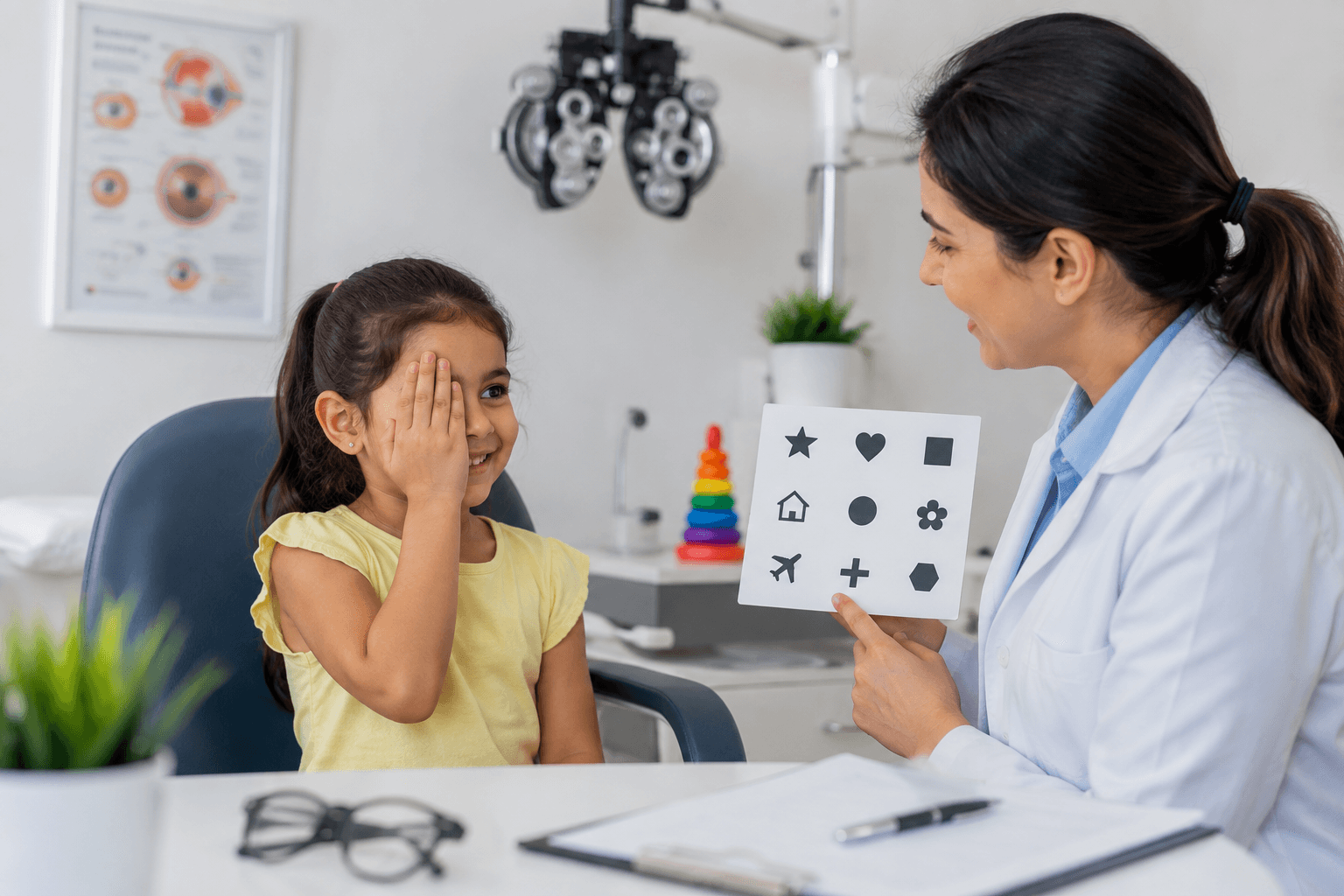
Eye assessments generally follow a child’s developmental stages. Basic checks form part of routine newborn and infant care. A more complete assessment before formal schooling begins is widely recommended, since this is the window when unequal vision is both most detectable and most treatable. School-age screenings then continue at intervals.
Screening is not the same as a full examination
This distinction matters more than most parents realise.
| Vision screening | Full eye examination | |
|---|---|---|
| Purpose | Quick check to flag obvious problems | Complete assessment of both eyes |
| Typically includes | Distance vision chart | Acuity, refraction, alignment, depth perception |
| Detects unequal vision? | Sometimes | Reliably |
| Performed by | School or community programme | Optometrist or ophthalmologist |
A child can pass a school screening and still have a meaningful difference between the eyes, because screenings often omit refraction, alignment testing and depth perception. If you have noticed any of the signs above, a full examination is the appropriate next step regardless of screening results. What those examinations actually measure is covered in how doctors measure differences between the two eyes.
Exact recommended ages vary between guidelines and countries, so ask your eye care professional for the schedule appropriate to your child.
What Early Support Actually Involves
Support is usually less involved than parents expect, particularly when a problem is caught early.
Accurate glasses come first. This is frequently the highest-impact step in the whole process, and when unequal vision is identified early, correction alone sometimes allows the weaker eye to improve substantially.
Any underlying cause is addressed. Misalignment, a cataract, or a lid position limiting one eye needs managing, since the brain has no reason to change its habits while one eye remains handicapped.
Where suppression has already developed, treatment targets the brain. Amblyopia treatment works on visual processing rather than the eye itself. Binocular and dichoptic approaches present slightly different images to each eye so a task can only be completed using both, encouraging the brain to fuse rather than suppress a different strategy from traditional patching, which covers the stronger eye rather than training the two together.
Consistency matters more than intensity. Short, regular sessions sustained over weeks generally outperform occasional long ones, and the same clinical measurements are repeated periodically to confirm progress.
What Early Support Protects
The value of acting early shows up in ordinary life rather than on a chart.
Depth perception supports catching a ball, judging stairs, cycling, and later, driving. Comfortable binocular vision supports reading endurance a child who tires quickly during close work may struggle in the classroom for reasons that have nothing to do with ability. Some careers carry vision standards that are easier to meet with balanced vision in both eyes. And there is a practical safeguard: if the stronger eye is ever injured or affected by illness, a well-developed second eye is a genuine backup.
None of this requires urgency bordering on panic. It requires a routine appointment at the right time.
Frequently Asked Questions
At what age should a child’s eyes first be examined? Basic checks begin in infancy as part of routine care, with a fuller assessment usually recommended before school starts. Specific ages vary between guidelines, so confirm the right schedule with your eye care professional.
Can a child have a vision problem and still see well? Yes. If one eye sees clearly, it compensates so effectively that the child appears to have normal vision. This is the main reason unequal vision goes undetected for years.
Does my child need glasses if only one eye is affected? Usually yes. Glasses correct each eye to its own requirement, giving the weaker eye the clearest possible image so the brain has a reason to start using it again.
Is it too late to treat a lazy eye after a certain age? Not necessarily. Treatment is faster and easier in early childhood, but binocular approaches have produced improvement in older children and adults too. Later treatment typically takes longer and requires more consistency.
My child passed a school vision screening is that enough? Not always. Screenings are useful but often skip refraction, alignment and depth perception testing. A child can pass one and still have a difference between the eyes worth investigating.