
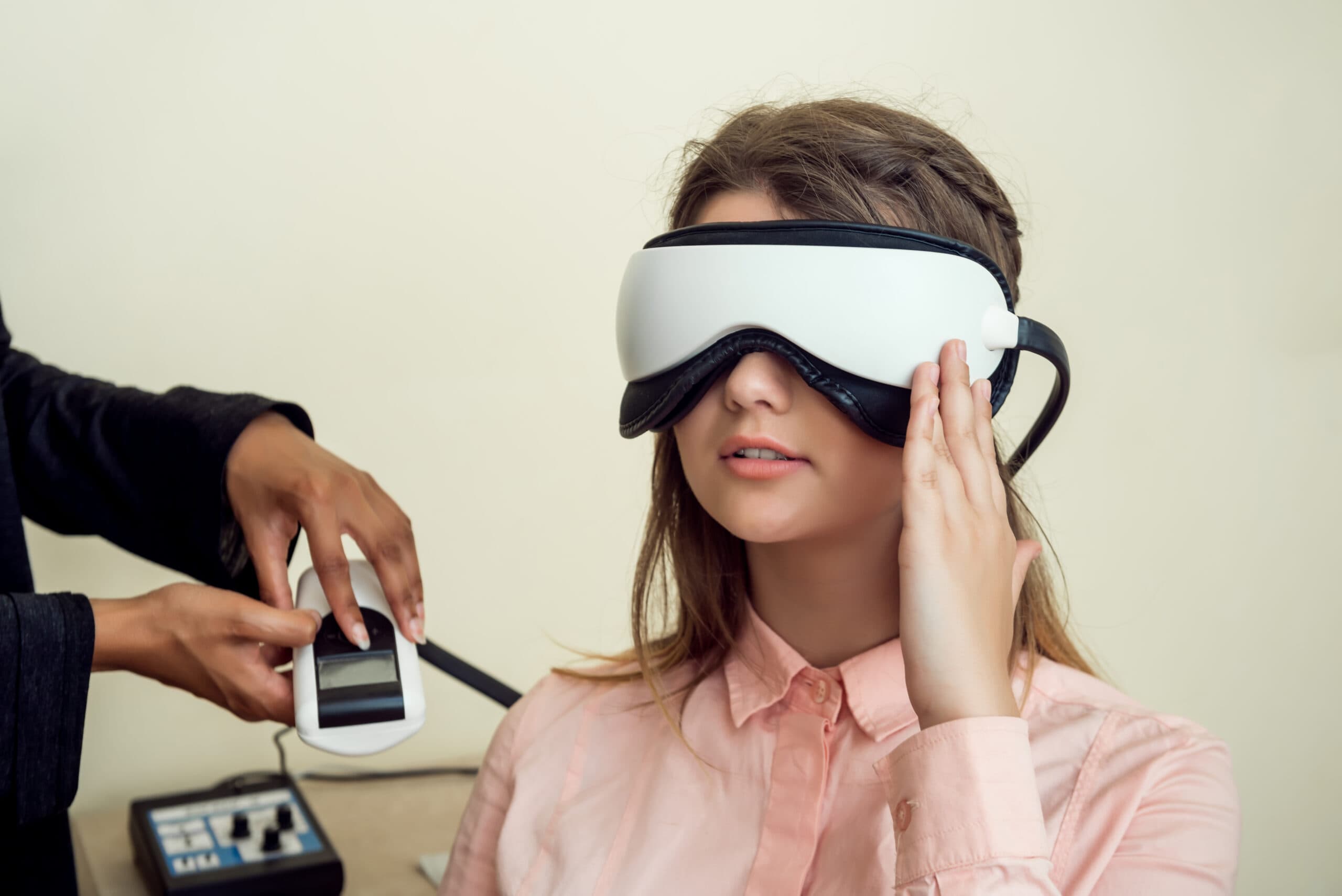

The year 2026 marks a pivotal turning point in ocular health. For decades, our approach to vision care was reactive we waited for the blur, the dryness, and the headaches to settle in before reaching for a pair of “computer glasses” or a bottle of eye drops. However, as our lives have become inextricably linked with spatial computing and persistent digital overlays, the old methods have proven insufficient.
As explored in our foundational resource, Digital Eye Strain in 2026, the sheer volume of digital data processed by the human eye has reached an all-time high. But if technology created the problem, it is now also providing the solution. We are entering an era of “Active Intervention,” where Artificial Intelligence (AI), Virtual Reality (VR), and bio-responsive wearables are transforming eye care from a manual chore into a seamless, automated wellness experience.
The Ocular Revolution of 2026
The shift in 2026 is fundamental: we are moving from passive protection to active intervention. In the past, “digital hygiene” meant remembering to look away from your screen. Today, your devices remember for you.
Traditional methods of managing Computer Vision Syndrome (CVS) often failed because they relied on human willpower. Humans are notoriously bad at monitoring their own physiological stress while focused on work. The “Ocular Revolution” of 2026 solves this by embedding diagnostic and therapeutic capabilities directly into the hardware we use every day. Technology is no longer just the catalyst for strain; it is becoming the primary cure.
AI-Driven Prevention: The “Invisible” Eye Doctor
Artificial Intelligence has moved beyond generative text and into the realm of real-time biological monitoring. Modern laptops, tablets, and even smartphones in 2026 now feature “Ocular AI” suites that act as an invisible physician sitting across from you.
Real-Time Monitoring and Machine Learning
Integrated infrared cameras and depth sensors now track microsaccades and blink rates with surgical precision. Most users don’t realize that when they are fatigued, their blink rate drops by nearly 60%, and their eyes begin to “drift” from the focal point. AI algorithms detect these subtle shifts long before the user feels a headache, allowing for preventative adjustments that stop Digital Eye Strain (DES) before it starts.
Automated Intervention and Dynamic Display Tuning
The most significant breakthrough is Predictive Display Adaptation. Instead of a static “Night Shift” mode, 2026 devices use AI to adjust:
- Luminance Balance: Matching screen brightness to ambient light in real-time to eliminate contrast-glare.
- Blue Light Modulation: Dynamically filtering high-energy visible (HEV) light based on the duration of your session rather than just the time of day.
- Text Scaling: Automatically increasing font size and contrast as the AI detects “ciliary muscle lag,” reducing the effort required to resolve fine details.
Smart Notifications and Biofeedback
We have moved past simple timers. AI now provides biofeedback prompts. Instead of a generic “take a break” message, your device might suggest, “Your blink rate has decreased by 40% in the last ten minutes. Take a 30-second focus reset now.” This personalized approach ensures that interventions only happen when biologically necessary.
The Paradox of VR: Healing the Eyes with Pixels
It may seem counterintuitive to suggest that wearing a screen inches from your eyes can cure eye strain, but the “VR Paradox” is one of the most successful medical trends of 2026.
Vergence-Accommodation Correction
One of the primary causes of strain in old-school digital use was the “fixed focal plane.” Your eyes stayed locked at one distance for hours. Modern VR headsets utilize varifocal lens technology. These lenses physically shift or use liquid crystal layers to change the focal depth. By forcing the eyes to focus at varying distances near, mid, and far within a virtual environment, VR actually “exercises” the ciliary muscles, preventing them from seizing up in a state of chronic contraction.
Gamified Ocular Recovery
Doctors are now prescribing “vision games” to rehabilitate strained eyes. As detailed in our specialized report on How doctors are now using VR games to cure digital eye strain in 2026, these applications use dichoptic training. By presenting different images to each eye, the brain is forced to strengthen the neural pathways associated with binocular vision. This doesn’t just rest the eyes; it trains them to be more resilient to future digital stress.
Smart Wearables and the “Digital Hygiene” Ecosystem
The 2026 wearable market has expanded beyond smartwatches to include devices specifically designed for “digital ocular hygiene.”
Smart Glasses: Liquid Crystal Lenses
The “Computer Glasses” of 2026 are highly sophisticated. Featuring liquid crystal layers, these lenses can detect when you are looking at a digital surface and apply a subtle “power boost” (typically +0.50 to +0.75 diopters). This takes the heavy lifting away from your internal eye muscles. When you look away from the screen, the lenses instantly return to your standard prescription or clear glass.
Haptic Wearables and Habit Formation
New wearable “neckbands” and smart rings now sync with your workstation. When the workstation’s AI detects high ocular stress, the wearable provides a gentle haptic vibration. This serves as a tactile cue to perform the Best Eye Exercises to Reduce Digital Eye Strain Fast in 2026. By pairing a physical sensation with a wellness habit, users are seeing a 70% higher compliance rate with eye exercises compared to manual reminders.
Why Modern Tech is Essential for Nighttime Recovery
A critical challenge in 2026 is the “carry-over effect” of digital use. Many users report that their eyes feel most strained after they have stopped using devices for the day.
The Circadian Reset
Smart home lighting systems now integrate with your digital devices to facilitate a “circadian reset.” When you close your work laptop, your environment’s LUX level and color temperature automatically shift to assist in ocular muscle relaxation.
This technological integration is vital because, as we explore in our deep dive on Why Digital Eye Strain Feels Worse at Night Even After You Stop Using Screens, the eyes often suffer from a “focusing spasm” that lasts for hours after screen exposure. 2026 recovery tech uses pulsating “red light therapy” and localized warmth to increase blood flow to the ocular area, accelerating the removal of metabolic waste from the eye muscles.
Practical Implementation: Merging Tech with Technique
Despite the brilliance of AI and VR, the most effective 2026 eye care strategy is a hybrid approach. You must merge high-tech automation with proven manual techniques.
The Tech-Enabled Exercise Routine
You shouldn’t just do eye exercises; you should do them when your data suggests you need them. Using an AI-prompted schedule, users can implement the “Figure-8 Drill” or “Near-Far Shifting” at the exact moment their ciliary muscles begin to fatigue.
By leveraging the best eye exercises, you provide a “manual override” to the digital system, ensuring that your eyes maintain their natural flexibility. The goal in 2026 is to use technology to tell us when to be human, when to blink, when to look at a real tree, and when to close our eyes for a moment of darkness.
The Ethical and Practical Future of Digital Vision
As we look toward 2030, the line between “eye care” and “performance enhancement” is blurring.
- Accessibility: A major focus for 2026 is ensuring AI vision therapy is available as a standard feature in all operating systems, not just high-end medical devices.
- Brain-Computer Interfaces (BCI): Preliminary trials are already looking at how BCIs can bypass the ocular nerve entirely to deliver visual data, potentially eliminating digital eye strain for those with severe vision impairment.
- Expert Prediction: Within the next five years, we expect “active lenses” to become as common as smartphones, making the concept of “tired eyes” a relic of the past.
Conclusion: Embracing the Future of Ocular Health
The future of digital eye strain care is bright, automated, and deeply integrated into our digital lives. We are no longer victims of our screens; we are becoming masters of our visual environments. By combining the foundational principles of ocular health found in our world with the AI and VR innovations of 2026, we can maintain peak performance in a pixel-heavy world.
The tools are here. The AI is watching. The VR is ready to heal. All that remains is for you to embrace the new standard of ocular wellness.
FAQs
Q: How does AI help with eye strain in 2026?
A: AI helps by using infrared sensors to track your blink rate and eye fatigue in real-time, automatically adjusting screen brightness and font sizes to reduce the load on your ciliary muscles.
Q: Can VR really cure digital eye strain?
A: Yes. Modern VR headsets use varifocal lenses and specialized vision therapy games to exercise the eyes and correct binocular vision dysfunction, which is often a root cause of chronic strain.
Q: What is the most effective eye exercise for fast relief?
A: The “Near-Far Zoom” and the “Figure-8 Tracking” exercises are currently rated as the most effective for quickly releasing tension in the eye’s focusing muscles.
Q: Why does my device keep changing color temperature?
A: In 2026, many devices use AI to sync with your local ambient light and your biological clock, reducing blue light exposure dynamically to protect your circadian rhythm.
Q: Are liquid crystal glasses better than standard blue light blockers?
A: Absolutely. Liquid crystal lenses are “active,” meaning they change their prescription power slightly when you look at a screen, whereas standard blue light blockers are “passive” and only filter light without reducing muscle strain.