
Yes, for many patients. Published studies on Bynocs’ home-based dichoptic therapy found significant improvement in the weaker eye’s visual acuity and in binocular function after about 6 weeks of 30-minute sessions. Results vary with age, the cause of the amblyopia, and consistency.
Lazy eye isn’t only about one blurry eye. It can affect how both eyes work together, how you judge depth, and how steadily you focus. So when families consider Online Vision Therapy for Lazy Eye, the real question is which skills it can improve, and by how much. This guide answers that with research on Bynocs, a skill-by-skill breakdown, and honest expectations.
What Is Online Vision Therapy for Lazy Eye?
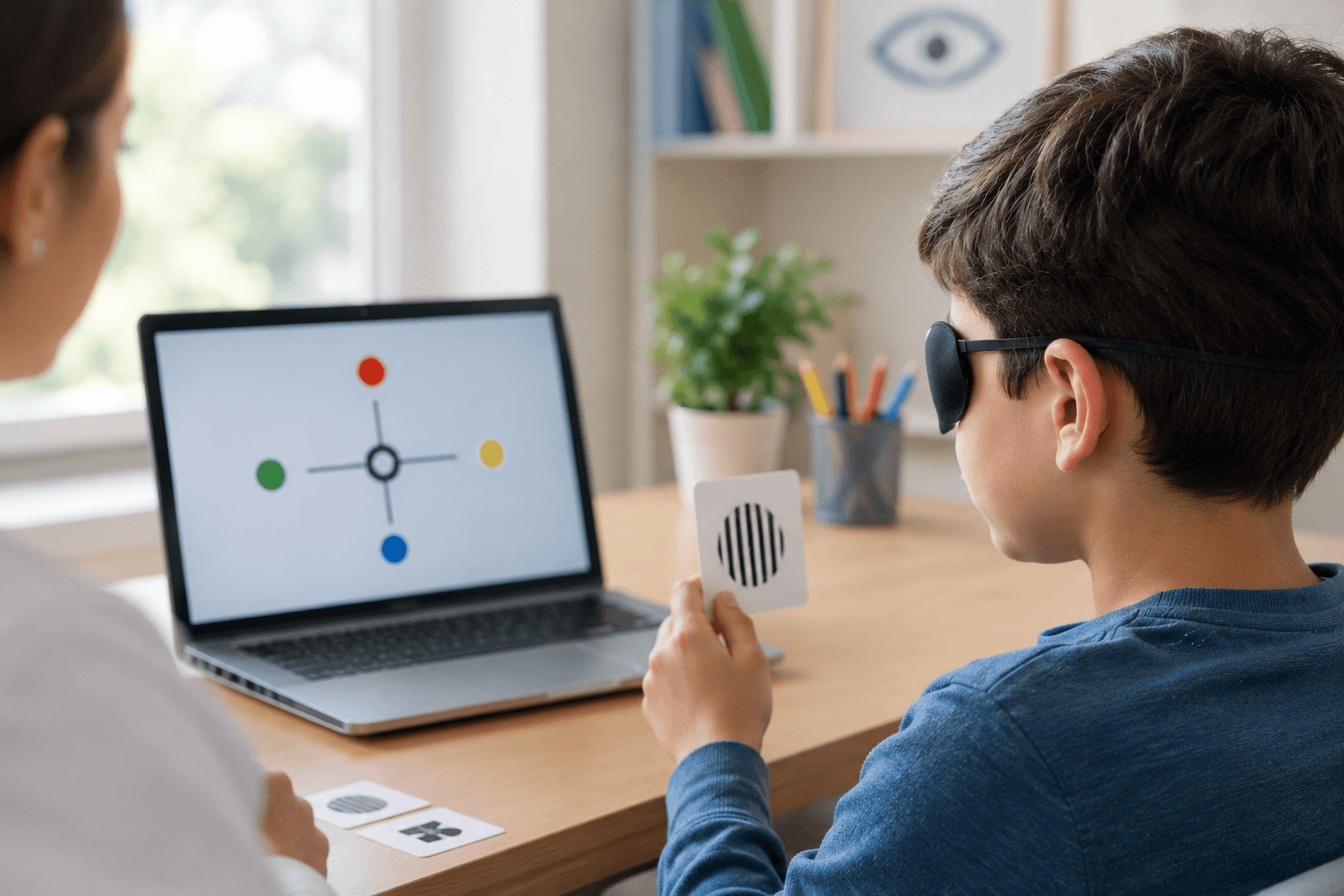
Online vision therapy for lazy eye is a home-based digital treatment that trains the brain to use the weaker eye and both eyes together. Patients play specially designed games on a computer while wearing colour-filter (anaglyph) glasses, and an eye care professional monitors progress remotely.
Unlike treatments that only cover or blur the stronger eye, this approach actively trains binocular vision. It targets the way the brain processes signals from each eye, which is where amblyopia really begins.
What Visual Skills Does Lazy Eye Affect?
Amblyopia happens when the brain favours one eye in childhood, often because of a prescription difference (anisometropia) or a squint (strabismus). Because the brain keeps relying on the stronger eye, the weaker eye’s signals are partly ignored, a process called suppression. As a result, several skills can fall behind.
| Visual skill | How lazy eye affects it | How online therapy trains it | Real-life sign of progress | How it’s measured |
| Visual acuity | Blurry detail in the weaker eye | Tasks with gradually finer targets | Reading small print more easily | Eye chart (logMAR) |
| Binocular function | The brain ignores (suppresses) the weaker eye | Dichoptic games that need both eyes | Less closing or covering of one eye | Binocular function tests |
| Depth perception | Weak 3D judgement | Layered or 3D visual tasks | Catching, pouring, using stairs | Stereo tests |
| Contrast sensitivity | Faint objects are hard to see | Low-contrast targets that adapt | Seeing better at dusk | Contrast tests |
| Fixation and tracking | Unsteady eye movements | Tracking and fixation games | Losing your place less when reading | Eye tracking data |
This skill-based view is why Bynocs amblyopia therapy looks beyond eyesight alone.
Why Visual Skills Matter More Than an Eye Chart Alone
An eye chart shows how clearly each eye sees, but everyday vision depends on much more. Reading needs steady fixation and smooth tracking. Sports need depth perception and quick eye-hand coordination. Driving in low light needs good contrast sensitivity.
A person can improve on the eye chart and still struggle if the eyes don’t work together well. That’s why skill-based therapy aims to improve both clarity and binocular function, so that gains show up in daily life, not only in the clinic.
What Does the Research Show?
Two peer-reviewed studies on the Bynocs platform show measurable change.
161 children aged 4–13: After a 30-minute, 5-days-a-week, 6-week protocol, the weaker eye improved by an average of 0.39 logMAR. Binocular function also improved significantly.
23 children aged 5–15: After 30 home sessions, visual acuity improved from 0.28 to 0.13 logMAR. The share of children with poorer vision (0.20 logMAR or worse) dropped from about 61% to about 22%.
What Does logMAR Mean, in Simple Terms?
logMAR is the scale eye doctors use to measure clarity, and lower numbers mean better vision. A change of 0.1 is roughly one line on an eye chart. So an average improvement of 0.39 is close to four lines, and moving from 0.28 to 0.13 is about one and a half lines. For a child, even a one- or two-line change can make classroom boards and books easier to read.
Which Skills Tend to Improve First?
In research and clinical practice, visual acuity and binocular function often show change first. Depth perception usually takes longer and varies more, especially when a squint is present. This is why realistic, skill-by-skill goals matter.
Once the weaker eye sees more clearly and suppression reduces, the brain has better input to build higher-level skills such as stereopsis. Your eye care professional will set targets for each skill and adjust them at every review.
How Online Therapy Trains Each Skill
Visual Acuity
Activities ask the weaker eye to spot targets that gradually become smaller and finer, encouraging the brain to process detail from that eye.
Binocular Function
Games are designed so that some elements are visible only to the weaker eye. To succeed, the brain must combine information from both eyes, which reduces suppression over time.
Depth Perception
Tasks use layered images that can only be judged correctly when both eyes contribute, helping the brain rebuild 3D vision where possible.
Contrast Sensitivity
Targets appear with lower contrast against their background, and the contrast adapts as the eye improves.
Fixation and Tracking
Moving targets and hold-steady tasks train smoother eye movements, which support reading and following objects.
Why Dichoptic Therapy Works on Visual Skills
In Bynocs therapy, each eye sees its own images through anaglyph glasses, and the stronger eye sees a dimmer picture. To play the game, the brain has to use the weaker eye alongside the stronger one. Repeated practice draws on neuroplasticity, strengthening connections in the visual cortex. AI-based difficulty keeps each task at the right level as skills grow. Learn more about how dichoptic vision therapy retrains the brain.
How Better Visual Skills Show Up in Everyday Life
As vision therapy for lazy eye progresses, some families notice:
- easier reading and fewer skipped lines
- better eye-hand coordination in sports and play
- more confidence with steps, pouring, and fine tasks
- more comfortable screen and study time
These changes are gradual and individual. See how vision therapy helps improve lazy eye and visual skills.
Signs Therapy May Be Working at Home
Parents are often the first to spot small changes. Examples include:
- a child who used to tilt their head or close one eye while watching TV now does it less
- fewer bumps into door frames or objects on the weaker side
- more interest in puzzles, drawing, or ball games
These are encouraging signs, but only clinical tests can confirm real progress. Share what you notice at review appointments.
How Is Progress Reviewed During Therapy?
Progress is checked in two ways.
Continuous data from each session. Bynocs records performance scores, session completion, and eye tracking data, and shares them with the eye care professional through the cloud.
Clinical tests at review visits. These include eye chart measurements, stereo tests, and binocular function tests.
Comparing both sources helps the professional decide whether to increase difficulty, change activities, or extend the program.
Who Can Benefit Most?
Online vision therapy may suit:
- children diagnosed with anisometropic or mild strabismic amblyopia
- children who find patching difficult to keep up
- teenagers and adults who want to improve binocular function
- people whose eye care professional recommends home-based training alongside clinic care
A professional assessment decides suitability, especially when a large squint or another eye condition is present.
Children vs Adults: Do Results Differ?
Children usually respond faster because their visual system is still developing. Adults keep some neuroplasticity and can still improve, although progress may be slower. Adults often find it easier to stay consistent with sessions. Learn about lazy eye treatment in adults.
What Affects How Much Skills Improve?
- Age at the start of treatment
- Cause and severity: anisometropic and strabismic amblyopia can respond differently
- Consistency: regular 30-minute sessions work better than irregular long ones
- Wearing prescribed glasses: this gives the brain a clear image to work with
- Regular reviews: these keep the plan matched to progress
Want to know which skills therapy could target for you or your child? Speak with the Bynocs team.
Tips to Get the Most From Therapy
- Complete sessions at the same time each day to build a habit.
- Keep prescribed glasses on during sessions if advised.
- Follow the recommended screen distance and lighting.
- Note any everyday changes and share them at reviews.
- Contact your eye care professional if you notice discomfort or double vision.
What Online Vision Therapy Can’t Do
Being clear about limits helps set the right expectations:
- It doesn’t straighten a large or constant squint. That may need clinical or surgical care.
- It doesn’t replace a diagnosis. An eye examination should always come first.
- It doesn’t work overnight. Skills build over weeks of consistent practice.
Can Lazy Eye Training Exercises Help at Home?
Yes, when your eye care professional recommends them. Lazy eye training exercises such as near-far focusing, Brock string practice, and tracking tasks can support therapy, but they don’t replace it. See 7 at-home lazy eye training exercises.
What Does an Online Program Involve?
Online vision therapy for amblyopia usually follows four stages:
- assessment
- setup with a computer and anaglyph glasses
- short daily sessions
- regular reviews
For a week-by-week walkthrough, read what to expect from an online amblyopia vision therapy program.
Frequently Asked Questions
Which visual skill improves first with online vision therapy?
Visual acuity and binocular function often show change first. Depth perception usually takes longer and varies more between individuals.
Can online vision therapy improve depth perception?
It can for some patients, because dichoptic and 3D-based activities train both eyes together. Results vary, especially with a squint, so stereo tests are used to track progress.
How much can vision improve with online therapy?
In one Bynocs study of 161 children, the weaker eye improved by an average of about four eye-chart lines over 6 weeks. Individual results vary.
Does online vision therapy work for adults with lazy eye?
Adults can benefit because the brain keeps some neuroplasticity. Progress may be slower than in children, and an assessment helps set goals.
Is online vision therapy better than patching?
The two work differently. Depending on the treatment plan, therapy may be used on its own or alongside patching. Your eye care professional will recommend the right approach.
Do improvements last after therapy ends?
Follow-up visits check whether gains stay stable. Your eye care professional may suggest periodic check-ups or maintenance sessions, and wearing prescribed glasses helps support results.
How many sessions are needed to see results?
Research on Bynocs used about 30 sessions over 6 weeks. Some people notice changes earlier, while others need a longer course. Your eye care professional will decide based on your progress.
Is online vision therapy safe?
When prescribed and monitored by an eye care professional, it is generally considered safe. It is non-invasive, and short sessions with proper screen setup help keep it comfortable.
Can online vision therapy help if patching didn’t work well?
It may. Online therapy trains both eyes to work together, which is a different approach from covering the stronger eye. Your eye care professional can assess whether it suits your situation.
Improve Lazy Eye Visual Skills With Bynocs
Lazy eye affects several visual skills, and online vision therapy can train them in a measurable way. Bynocs combines dichoptic games, adaptive difficulty, and remote monitoring, backed by published research. Speak with your eye care professional to find out which skills therapy could target and whether online vision therapy is the right next step.