
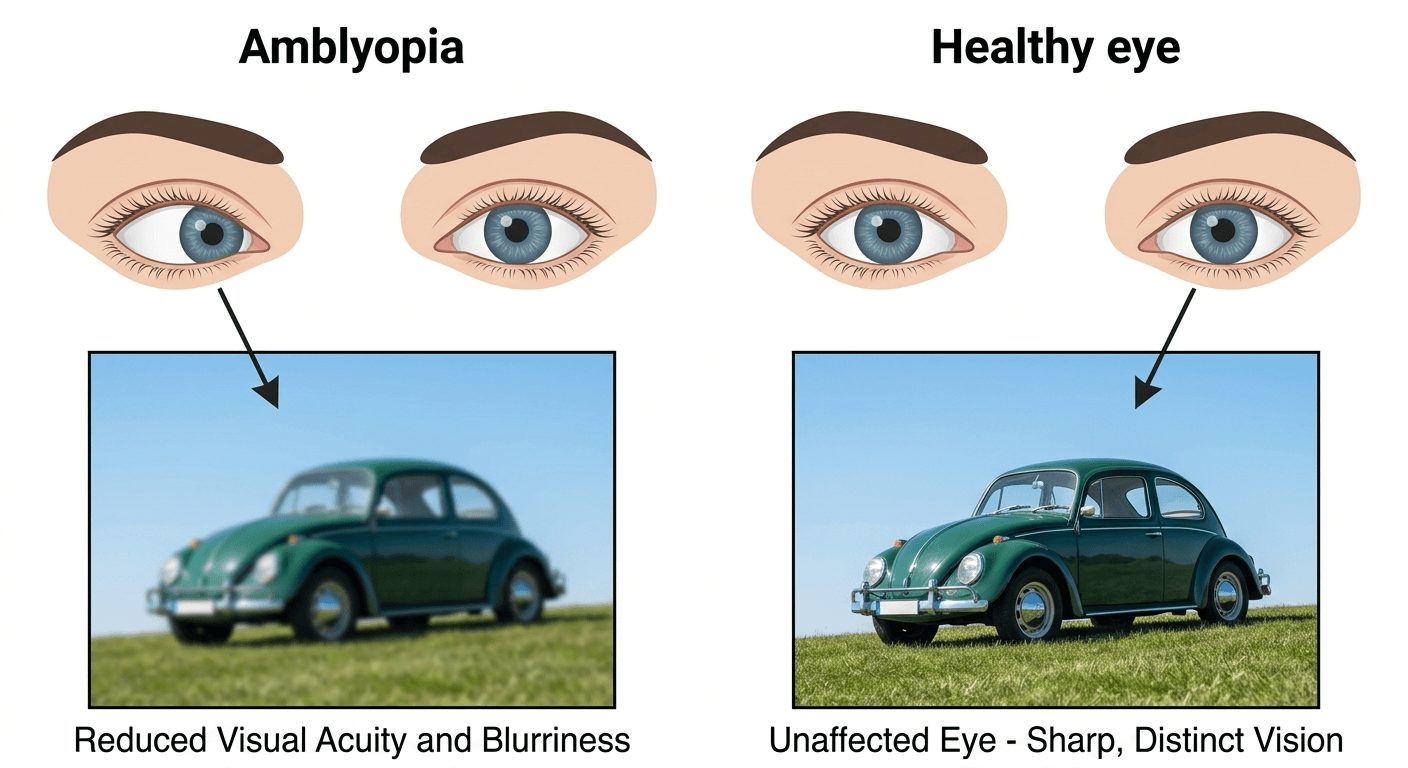
Did you know that approximately 1 in 40 children develops lazy eye, yet 90% of cases can be successfully treated when caught early? Lazy eye, medically known as amblyopia, is the leading cause of vision loss in children worldwide but it doesn’t have to be permanent.
If you’ve noticed your child squinting, tilting their head, or struggling with depth perception, you’re right to seek answers. The good news is that modern lazy eye treatment options, including innovative digital therapies, offer higher success rates than ever before.
In this comprehensive guide, you’ll discover exactly what lazy eye amblyopia is, why it develops, how to recognize the warning signs, and most importantly what amblyopia treatment options can help restore healthy vision for life
Based on the content source links: Lazy Eye Treatment: Advanced Digital Therapy for All Ages
Understanding Lazy Eye in Simple Terms
Lazy eye (amblyopia) is a vision development disorder where one eye fails to achieve normal visual acuity, even with prescription glasses or contact lenses. Despite the name, the eye isn’t actually “lazy” the problem lies in how the brain and eye communicate with each other.

Here’s what happens during childhood visual development:
- The brain receives images from both eyes simultaneously
- When one eye sends a blurry or misaligned image, the brain starts to ignore or “suppress” input from that eye
- Over time, the visual pathways between the ignored eye and brain don’t develop properly
- This results in permanently reduced vision that glasses alone cannot correct
Key insight: Amblyopia is a brain-vision connection problem, not an eye muscle problem. This is why lazy eye therapy focuses on retraining the brain to use the weaker eye.
Medical Definition of Amblyopia
According to the American Academy of Ophthalmology, amblyopia is defined as:
“A unilateral or bilateral reduction in best-corrected visual acuity caused by pattern vision deprivation or abnormal binocular interaction during the critical period of visual development.”
Clinical diagnostic criteria include:
- Visual acuity of 20/40 or worse in the affected eye
- At least two lines difference in visual acuity between eyes
- No structural eye disease explaining the vision loss
- Development occurs during the critical period (birth to age 7-9)
How Common is Lazy Eye?
Global prevalence statistics:
- Affects 2-4% of the general population
- Most common cause of monocular vision loss in children and adults under 40
- Accounts for more childhood vision loss than all injuries and diseases combined
- Slightly higher prevalence in premature infants (up to 6%)
- No significant gender difference
The critical takeaway: Early detection and treatment are essential. Studies show that 90-95% of children who receive lazy eye amblyopia treatment before age 7 achieve significant vision improvement.
The Three Types of Amblyopia (Lazy Eye)
Understanding which type of amblyopia your child has is crucial for determining the most effective lazy eye cure approach.

Type 1: Strabismic Amblyopia
What it is: Caused by misalignment of the eyes (strabismus), where one eye turns inward, outward, upward, or downward.
How it develops: When eyes don’t align properly, they send different images to the brain. To avoid double vision, the brain suppresses the image from the misaligned eye, leading to amblyopia.
Prevalence: Accounts for approximately 40% of amblyopia cases
Visual signs to watch for:
- Noticeable eye turn (constant or intermittent)
- One eye looking in a different direction
- Loss of depth perception
- Head tilting to compensate
Type 2: Refractive Amblyopia
What it is: Caused by a significant difference in refractive error (prescription) between the two eyes, a condition called anisometropia.
How it develops: When one eye is much more nearsighted, farsighted, or astigmatic than the other, the brain receives a consistently clearer image from one eye and suppresses the blurrier eye.
Prevalence: Accounts for approximately 50% of amblyopia cases
Why it’s easily missed:
- No obvious physical signs
- Children don’t complain (they don’t know vision should be better)
- Both eyes appear straight
- Often discovered only during vision screenings
Common refractive differences that cause amblyopia:
- More than 1.00 diopter difference in nearsightedness
- More than 1.50 diopter difference in farsightedness
- More than 1.50 diopter difference in astigmatism
Type 3: Deprivation Amblyopia
What it is: Caused by something physically blocking light from entering and focusing in the eye during early development.
Common causes:
- Congenital cataracts (clouding of the lens)
- Corneal scarring or opacity
- Severe ptosis (drooping eyelid covering the pupil)
- Vitreous hemorrhage
Prevalence: Accounts for approximately 10% of amblyopia cases but is the most severe form
Why it’s urgent: This type requires immediate treatment. The vision obstruction must be removed surgically as soon as possible, followed by aggressive amblyopia treatment to develop visual pathways.
Comparison of Amblyopia Types
| Type | Cause | Detectability | Severity | Treatment Urgency |
| Strabismic | Eye misalignment | Easily visible | Moderate | High |
| Refractive | Unequal prescription | Often hidden | Mild-Moderate | Moderate |
| Deprivation | Vision obstruction | Usually visible | Severe | Emergency |
What Causes Lazy Eye? Risk Factors & Origins
Amblyopia develops due to specific conditions that interfere with normal visual development during childhood.
Primary Causes of Amblyopia
1. Strabismus (Eye Misalignment)
- Most common identifiable cause
- Can be convergent (esotropia), divergent (exotropia), or vertical
- May be present from birth or develop in early childhood
- Strong genetic component in many cases
2. Significant Refractive Error Differences
- Anisometropia (unequal prescription between eyes)
- High refractive error in both eyes (bilateral amblyopia)
- Astigmatism in one or both eyes
3. Visual Deprivation
- Anything blocking the visual axis
- Must be addressed urgently to prevent permanent vision loss
Critical Risk Factors
Research has identified several factors that significantly increase a child’s risk:
Family History & Genetics
- 3x higher risk if a parent had amblyopia
- 6x higher risk if a sibling has amblyopia
- Certain genetic syndromes associated with increased risk
Birth & Development Factors
- Premature birth (especially before 32 weeks gestation)
- Low birth weight (under 1,500 grams)
- Developmental delays
- Cerebral palsy
- Down syndrome
Maternal Factors
- Smoking during pregnancy
- Alcohol or drug use during pregnancy
- Certain infections during pregnancy
The Critical Period of Visual Development
Understanding why early intervention matters requires understanding visual development:
Birth to 3 months:
- Rapid development of visual pathways
- Eyes learning to work together
- Binocular vision foundations forming
3 months to 3 years:
- Peak plasticity period
- Binocular vision solidifies
- Neural connections strengthen
- Maximum responsiveness to lazy eye therapy
3 to 7-9 years:
- Critical period continues but gradually closes
- Still highly treatable
- Success rates remain very high with proper treatment
After age 9:
- Traditional view: “critical period closed”
- Modern research: Brain plasticity continues
- Treatment still possible with newer technologies
- Digital therapies showing promise for teens and adults
Recognizing Lazy Eye: Signs and Symptoms
One of the biggest challenges with amblyopia is that children rarely complain about their vision they simply don’t know what “normal” vision should be.
Symptoms in Infants (0-12 months)
Watch for these warning signs in your baby:
- Eyes that don’t move together in the same direction
- One eye consistently wandering or drifting
- Crying or fussing when one eye is covered
- Difficulty tracking objects or faces
- Excessive tearing in one eye
- White reflection in the pupil (seek immediate medical attention)
- Drooping eyelid that covers the pupil
Symptoms in Toddlers & Young Children (1-5 years)
- Squinting or closing one eye, especially in bright light
- Frequent eye rubbing
- Head tilting or turning to use one eye
- Sitting very close to the TV
- Difficulty with hand-eye coordination tasks
- Clumsiness or bumping into objects on one side
- Avoiding activities requiring depth perception
Symptoms in School-Age Children (5+ years)
- Poor performance in school, especially reading
- Complaints of tired or strained eyes
- Difficulty seeing 3D movies or images
- Poor depth perception
- Difficulty with sports requiring ball-hand coordination
- One eye noticeably turning in, out, up, or down
Why Lazy Eye is Often Missed
The compensation factor: The brain compensates remarkably well with the stronger eye, so children often function well enough that parents don’t notice a problem.
No pain: Unlike many health conditions, amblyopia doesn’t hurt, so there’s no discomfort to alert parents.
Subtle in refractive cases: When both eyes appear straight and aligned, there may be no visible signs at all.
Children don’t self-report: Young children don’t know their vision is abnormal.
Parent Checklist: When to See an Eye Doctor
Schedule a comprehensive eye examination if your child:
- ☐ Has a family history of lazy eye or childhood eye problems
- ☐ Was born prematurely or with low birth weight
- ☐ Shows any of the symptoms listed above
- ☐ Fails a vision screening at school or pediatrician
- ☐ Has developmental delays
- ☐ Tilts their head consistently when looking at objects
- ☐ Sits very close to screens or holds books very close
Don’t wait for obvious symptoms. The American Optometric Association recommends comprehensive eye exams at:
- 6 months of age
- 3 years of age
- Before kindergarten (age 5)
- Annually throughout school years
How is Lazy Eye Diagnosed?
Early and accurate diagnosis is essential for successful lazy eye amblyopia treatment outcomes.
Vision Screening vs. Comprehensive Eye Exam

Vision Screening (Basic):
- Quick assessment (5-10 minutes)
- Often performed by pediatrician or school nurse
- Identifies potential problems requiring further examination
- May miss subtle cases of amblyopia
Comprehensive Eye Examination (Thorough):
- Performed by optometrist or ophthalmologist
- 30-60 minutes
- Detailed assessment of all aspects of vision
- Can definitively diagnose amblyopia and determine type
- Necessary for treatment planning
Diagnostic Tests for Amblyopia
1. Visual Acuity Testing
- Measures how clearly each eye sees
- Age-appropriate charts used (pictures for toddlers, letters for older children)
- Each eye tested separately
- Amblyopia diagnosed when there’s 2+ line difference between eyes
2. Cover Test
- Gold standard for detecting strabismus
- Doctor covers one eye at a time and watches how the other eye responds
- Reveals even subtle eye misalignments
3. Refraction Assessment
- Determines exact prescription needed
- Identifies refractive differences between eyes
- Critical for diagnosing refractive amblyopia
4. Eye Health Examination
- Dilated pupil examination
- Checks for cataracts, retinal problems, optic nerve health
- Rules out structural causes of vision loss
Recommended Eye Exam Schedule
| Age | Examination Type | What’s Assessed |
| 6-12 months | Comprehensive exam | Eye health, visual development, alignment |
| 3 years | Comprehensive exam | Visual acuity, alignment, refractive error |
| 5 years (before kindergarten) | Comprehensive exam | Detailed vision assessment, amblyopia screening |
| Annual (ages 6-18) | Comprehensive exam | Monitor development, detect emerging issues |
Lazy Eye Treatment Options: From Traditional to Modern Innovations
The goal of all amblyopia treatment is to force the brain to use the weaker eye, strengthening neural pathways and improving vision.
For a comprehensive breakdown of all treatment approaches, read our detailed guide: What are the Treatment Options for Lazy Eye?
Traditional Lazy Eye Treatment Methods

1. Corrective Lenses (Glasses or Contact Lenses)
How it works: Corrects underlying refractive error, ensuring each eye receives a clear image.
When it’s used:
- First-line treatment for refractive amblyopia
- Often sufficient for mild cases
- Always necessary before other treatments
Success rates: For mild refractive amblyopia, glasses alone achieve improvement in 25-40% of cases.
2. Eye Patching (Occlusion Therapy)
How it works: Patches the stronger eye, forcing the brain to use the weaker eye.
Patching protocols:
- Mild amblyopia: 2 hours per day
- Moderate amblyopia: 4-6 hours per day
- Severe amblyopia: 6+ hours per day
- Duration: Typically 3-6 months
Success rates: 75-90% of children show improvement with consistent patching.
Pros and Cons:
- ✅ Well-established, evidence-based treatment
- ✅ No side effects, relatively low cost
- ❌ Compliance challenges (children resist wearing patches)
- ❌ Social stigma concerns
3. Atropine Eye Drops
How it works: Atropine drops blur vision in the stronger eye by dilating the pupil, forcing reliance on the weaker eye.
Typical protocol:
- 1 drop in stronger eye
- Once daily to once weekly
- Treatment duration: 6-12 months
Success rates: Studies show atropine is similarly effective to patching for moderate amblyopia.
Pros and Cons:
- ✅ Better compliance than patching
- ✅ Less socially noticeable
- ❌ Side effects: Light sensitivity, difficulty with near vision
Modern & Advanced Lazy Eye Therapy Options

4. Digital Therapeutic Solutions & Dichoptic Training
How it works: Uses specialized computer programs, tablets, or virtual reality systems that present different images to each eye simultaneously, training eyes to work together while strengthening the weaker eye.
Technologies include:
- Dichoptic video games
- Virtual reality therapy
- Tablet-based programs
Bynocs AmblyGo is a leading digital therapeutic platform that uses evidence-based dichoptic stimulation technology. The system presents video-based activities where both eyes are engaged simultaneously but the weaker eye receives stronger stimulation, promoting binocular vision development.
Success rates: Recent clinical studies show 60-75% of children achieve 2+ lines of visual acuity improvement with digital therapies, with significantly higher compliance rates than traditional patching.
Pros:
- ✅ Extremely high compliance (90%+ due to engaging format)
- ✅ Promotes binocular vision development
- ✅ Can be effective for older children and adults
- ✅ Measurable, trackable progress
- ✅ No social stigma
5. Vision Therapy (Orthoptics)
How it works: Supervised program of eye exercises and activities designed to improve eye coordination, focusing abilities, and visual processing.
What’s involved:
- In-office sessions with vision therapist (typically weekly)
- Prescribed home exercises (daily, 15-30 minutes)
- Duration: 3-12 months typically
Best for:
- Strabismic amblyopia with binocular vision issues
- Patients needing to develop depth perception
- Combination treatment approach
Treatment Comparison: Quick Reference
| Treatment | Effectiveness | Compliance | Age Range | Typical Duration |
| Glasses Only | Moderate | High | All ages | 3-6 months |
| Patching | High | Moderate | 3-12 years | 3-6 months |
| Atropine | Moderate-High | High | 3-12 years | 6-12 months |
| Digital Therapy | High | Very High | 5-adult | 3-6 months |
| Vision Therapy | High | Moderate | 5-adult | 6-12 months |
How Long Does Lazy Eye Treatment Take?
One of the most common questions parents ask is: “How long until we see results?”
For detailed information on treatment duration and what to expect month by month, see our guide: How Long Does Lazy Eye Treatment Take?
Factors That Affect Treatment Duration
1. Age at Treatment Start
- Ages 3-5: Fastest response (peak plasticity)
- Ages 6-8: Still excellent response
- Ages 9-12: Slower but significant improvement possible
- Teens/Adults: Treatment takes longer but success is possible
2. Severity of Amblyopia
- Mild (20/30-20/40): 3-4 months average
- Moderate (20/50-20/80): 6-9 months average
- Severe (20/100 or worse): 12-24 months or longer
3. Type of Amblyopia
- Refractive: Often responds relatively quickly
- Strabismic: May require longer treatment
- Deprivation: Requires intensive, prolonged treatment
4. Treatment Compliance
- Consistent daily treatment: Expected timeline applies
- Inconsistent treatment: Progress significantly delayed
Typical Treatment Timelines
Initial Improvement Phase (Weeks 4-12):
- First measurable improvements typically seen
- Visual acuity may improve 1-2 lines on eye chart
Active Treatment Phase (Months 3-12):
- Steady, progressive improvement
- Regular monitoring every 4-8 weeks
- Goal: Reduce inter-eye difference to 1 line or less
Maintenance Phase (Months 12-24):
- Part-time treatment continuation
- Prevents regression
- Gradual weaning from treatment
When Should You Start Lazy Eye Treatment?
Timing is everything with lazy eye cure approaches. Starting early dramatically improves outcomes.
For a deep dive into optimal treatment timing, read: When Should You Start Lazy Eye Treatment
The Earlier, The Better: Here’s Why
Peak neuroplasticity: The visual system is most adaptable during early childhood.
Research data:
- Treatment before age 5: 90-95% success rate
- Treatment ages 5-7: 80-90% success rate
- Treatment ages 7-12: 60-80% success rate
- Treatment ages 12+: Variable success; emerging treatments showing promise
Treatment Recommendations by Age
- Birth to 3 Years: Early intervention is critical. Address underlying causes (e.g., cataracts or strabismus) immediately to allow the visual system to develop. Patching is the primary gold standard during this phase.
- Ages 3 to 7: This is the prime “window of opportunity.” Aggressive treatment with patching, glasses, or atropine yields the best results. Digital therapies can also be introduced for better compliance.
- Ages 8 to 12: Treatment remains highly effective. Digital therapeutic systems and active vision therapy are often preferred here as they are more engaging and easier for school-aged children to manage.
- Teenagers & Adults: While once considered “too late,” modern research confirms the adult brain retains plasticity. Treatment usually involves a combination of refractive correction and intensive digital dichoptic training. It takes longer than in childhood, but improvement is achievable.
Frequently Asked Questions (FAQs)
1. Can lazy eye go away on its own?
No. Amblyopia will not resolve on its own. Because it is a “brain-vision” connection issue, the brain will continue to suppress the input from the weaker eye to avoid blurry or double images. Without intervention to “force” the brain to use the weaker eye, the vision loss often becomes permanent.
2. Is lazy eye permanent if left untreated?
If not treated during the “critical period” of development (birth to roughly age 7-9), the brain’s neural pathways for the weaker eye may not fully develop, leading to permanent, irreversible vision loss. This is why early screening is so vital; once the visual system is fully mature, it is significantly harder (though not always impossible) to restore acuity.
3. Can adults be treated for amblyopia?
Yes. For decades, it was believed that the window for treatment closed around age 9. However, current research into neuroplasticity has shown that the adult brain is capable of learning and adapting. While treatment for adults often takes longer and requires more intensive methods such as advanced digital dichoptic training many adults can see significant improvements in visual acuity and binocular vision.
4. Does excessive screen time cause lazy eye?
No, excessive screen time does not directly cause lazy eye. However, it can make it harder for parents to identify the condition. Because children may become hyper-focused on screens, they might not complain about their vision, and parents might assume their child is simply “focused” rather than struggling to see. Furthermore, intense near-work can exacerbate underlying refractive errors (like nearsightedness), which can lead to refractive amblyopia.
5. What happens if treatment is stopped too early?
Stopping treatment before the eye doctor gives the “all clear” often leads to regression. The brain may revert to its old habit of suppressing the weaker eye. Doctors typically implement a “weaning” period, where patch time or digital therapy sessions are slowly decreased rather than stopped abruptly, to ensure the improvements are permanent.
6. Will my child need glasses forever?
That depends on the type of amblyopia. If the lazy eye was caused by a large difference in prescription (refractive amblyopia), the child may continue to need glasses to keep the vision clear and prevent the amblyopia from returning. However, if the underlying issue is corrected and the eyes are properly aligned, some children may eventually move to lower prescriptions or only need glasses for specific tasks like reading or driving.
7. Is lazy eye hereditary?
Genetics play a significant role. If a parent or sibling had amblyopia, a child is at a much higher risk of developing it. If you have a family history of lazy eye, strabismus, or high refractive errors, it is recommended that your child has their first comprehensive eye exam before the age of 3, rather than waiting for symptoms to appear.