
|Written by: Md Oliullah Abdal, Clinical Optometrist & COO, Bynocs
| Medically reviewed by: Dr. Gul J. Nankani, Ophthalmologist & Founder, Bynocs
| Published: 25 January 2026 | Last updated: 14 October 2026 | 9 min read
What is digital eye strain?
Digital eye strain is a group of eye and vision symptoms caused by long periods of screen use. The American Optometric Association (AOA) also calls it computer vision syndrome (AOA).
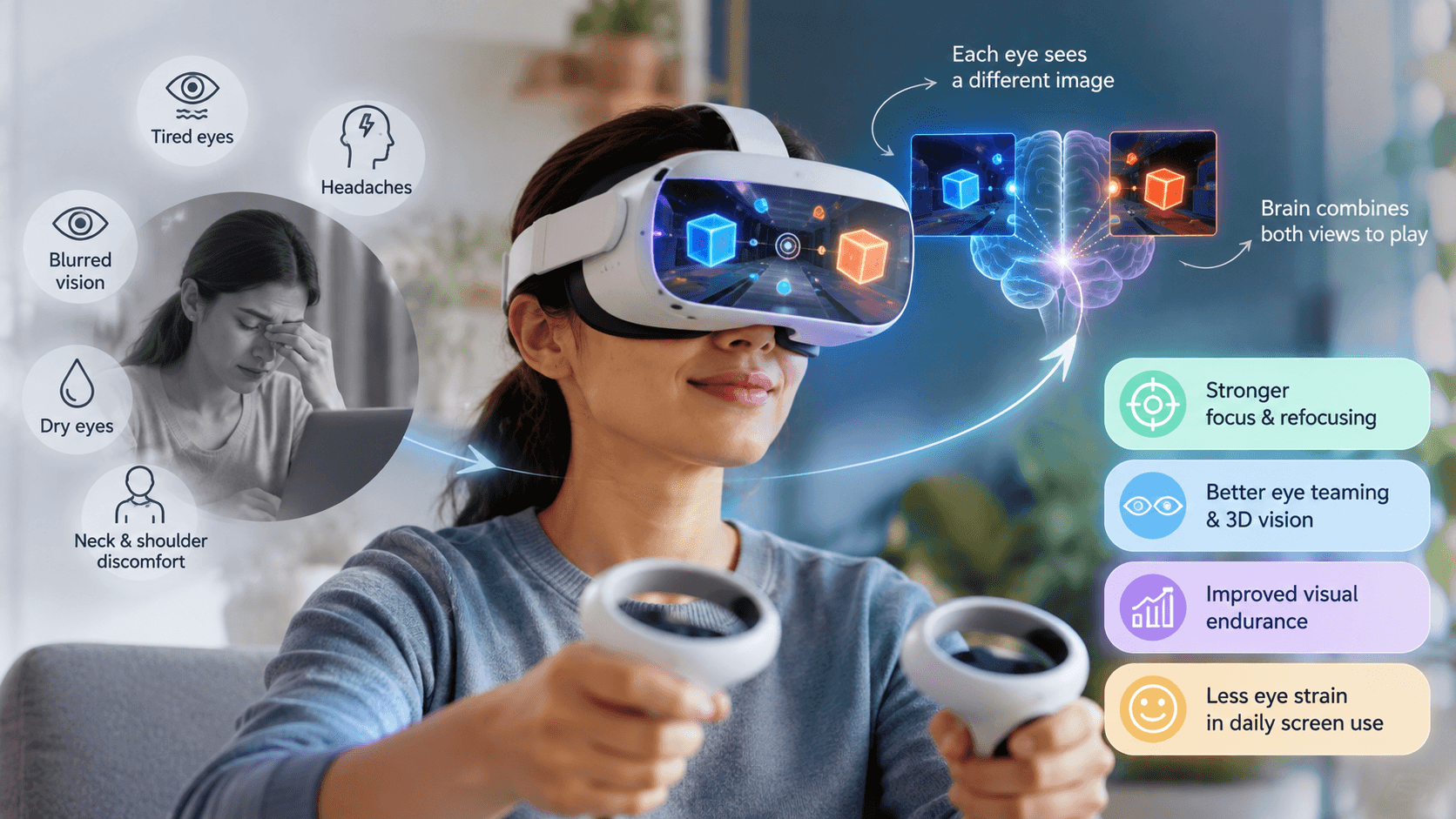
Common symptoms include:
- Tired, sore or burning eyes
- Blurred vision after screen work
- Headaches, often around the forehead or temples
- Dry or watery eyes
- Neck and shoulder discomfort
- Difficulty refocusing from the screen to distant objects
One key reason is blinking. The American Academy of Ophthalmology (AAO) notes that people blink much less often when they focus on a screen, which lets the tear film dry out (AAO). At the same time, the focusing muscles inside the eye stay “switched on” for hours. You can read more on our digital eye strain condition page.
Why are doctors turning to VR and game-based therapy?
Doctors use game-based therapy because many people with digital eye strain have weak or tired visual skills, not just dry eyes. Two skills matter most:
- Accommodation – the eye’s ability to focus and refocus at different distances.
- Vergence – the ability of both eyes to turn inward or outward together so you see one clear image.
When these skills fatigue quickly, screen work feels harder by the afternoon. Traditional vision therapy trains them with lenses, prisms and repetitive drills. Games do the same job in a format people actually complete, and software can record every session so the clinician sees real progress.
What does “dichoptic” mean?
Dichoptic means each eye is shown a slightly different image. In a dichoptic game, part of the picture goes to the left eye and part goes to the right eye, so the brain must combine both views to play. VR headsets and special glasses used with a computer screen can both deliver this effect.

Not Sure What’s Causing Your Eye Strain?
Experiencing frequent headaches, blurred vision or tired eyes after screen time? A binocular vision assessment can help identify whether focusing or eye-teaming difficulties are contributing to your symptoms.
Book an Eye Assessment →Understand your symptoms with guidance from an eye care professional.
How does VR game therapy for digital eye strain work?
Game-based therapy follows a clinical process, not a download-and-play model.
- Assessment: An optometrist or ophthalmologist checks your prescription, focusing, eye teaming, tear film and screen habits.
- Prescription: The clinician chooses games and difficulty levels that target your weakest skills.
- Short sessions: You play for a set time, often 15–30 minutes, on most days of the week, at home or in the clinic.
- Progress review: The software logs accuracy, speed, and endurance. The clinician adjusts difficulty and decides when you are done.
[Insert image: digital-eye-strain-therapy-steps.png]
Types of therapy games and what each one trains
| Game type | Visual skill trained | How it helps with screen strain |
|---|---|---|
| Focus-shifting games (near-to-far targets) | Accommodation (focusing flexibility) | Makes refocusing between screen and room faster and less tiring |
| Fusion and 3D depth games | Vergence and binocular vision | Keeps both eyes aligned on near work for longer without fatigue |
| Dichoptic contrast games | Binocular balance (both eyes working equally) | Reduces the effort of combining two images during long sessions |
| Tracking and pursuit games | Eye movement control | Supports smoother reading and scrolling |
| Timed endurance challenges | Visual stamina | Builds tolerance for longer work blocks before symptoms start |
What does the research say – and what doesn’t it show yet?
Being clear about the evidence matters, especially for health decisions.
- Vergence and focusing therapy works for convergence insufficiency. A large National Eye Institute–funded trial (the Convergence Insufficiency Treatment Trial) found that office-based vision therapy with home reinforcement was the most effective treatment for this eye-teaming problem, a frequent contributor to near-work strain (CITT Group, 2008).
- Dichoptic game therapy has strong evidence in lazy eye. A randomised trial published in Ophthalmology showed children using a dichoptic digital therapy gained more vision than those wearing glasses alone (Xiao et al., 2022). In 2021, the US FDA cleared the first dichoptic digital therapy – for amblyopia, not for digital eye strain (AAO).
- Bynocs has published its own peer-reviewed data. A study of 161 children using the Bynocs dichoptic platform reported significant vision gains after 30-minute sessions, five days a week, for six weeks (Abdal et al., Brain Sciences, 2022).
- For digital eye strain specifically, research is still growing. Reviews agree that digital eye strain is multi-factorial, so therapy works best when combined with dry-eye care, correct glasses and better screen habits (Kaur et al., 2022).
Is VR safe for your eyes?
VR used for supervised therapy is generally considered safe for most adults and older children, but it is not risk-free. Headsets create vergence accommodation conflict: your eyes turn in for a “near” object while focusing at a fixed screen distance. For some people this causes temporary tiredness, headache or mild nausea.
Safe use looks like this:
- Sessions are short and prescribed, not open-ended gaming.
- Your clinician checks symptoms at every review.
- Children use headsets only if the manufacturer’s age guidance and the clinician allow it.
- Screen-based therapy with special glasses is an alternative if a headset feels uncomfortable.
Who is a good candidate for game based therapy?
You may benefit if you answer “yes” to two or more of these:
- Your eyes feel tired or strained after 1–2 hours of screen work.
- Words blur, move or double after reading for a while.
- You get headaches after near work that ease on weekends.
- Refocusing from screen to distance feels slow.
- Eye drops and breaks help only a little.
Therapy is not a replacement for an eye exam. Sudden vision loss, eye pain, flashes or new floaters need urgent in-person care.
How much does VR or digital vision therapy cost in India?
The cost of digital vision therapy in India depends on four things:
- Assessment fees at the clinic (a one-time binocular vision work-up).
- Programme length – most plans are built around a set number of weeks or sessions.
- Home vs in clinic delivery – home programmes reduce travel and clinic time.
- Follow-up reviews included in the plan.
Most standard health insurance policies in India do not cover outpatient vision therapy, although some OPD add-ons may. Ask your eye care provider for a written plan that lists total sessions, reviews and fees before you start. Bynocs partner clinics can share programme pricing after your assessment.
How does DeStrain by Bynocs fit in?
DeStrain is Bynocs’s clinician-supervised digital therapy for digital eye strain and computer vision syndrome. It uses interactive visual exercises to train focusing, eye teaming and visual endurance, and it reports progress to your eye care professional after each session. It is used alongside the everyday habits below, not instead of them.
Everyday habits that make therapy work better
- Follow the 20-20-20 rule: every 20 minutes, look at something 20 feet (6 metres) away for 20 seconds (AOA).
- Blink on purpose during long reading tasks.
- Set up your screen about an arm’s length away and slightly below eye level.
- Reduce glare with soft room lighting and matched screen brightness.
- Skip the blue-light hype: a 2023 Cochrane review found blue-light filtering glasses probably make no difference to eye strain (Cochrane).
If your eyes feel worse in the evening, read why digital eye strain feels worse at night. Parents of teenagers may also find why teens have more eye fatigue than adults useful, and our guide to gamified vision therapy for computer vision syndrome goes deeper into the skills involved.
BYNOCS DESTRAIN VISION THERAPY
Struggling With Screen Fatigue Every Day?
A binocular vision assessment can help identify whether weak focusing or eye-teaming skills are contributing to your symptoms. Bynocs partner eye clinics offer DeStrain therapy with clinician-tracked progress.
Frequently Asked Questions
Can VR games really help with digital eye strain?
VR and screen-based therapy games can help when your symptoms come from weak focusing or eye-teaming skills. They train accommodation, vergence and visual endurance in a structured way. Results depend on an accurate diagnosis, regular sessions and good screen habits, so start with an eye exam.
Is VR bad for your eyes?
Short, supervised VR sessions are not known to damage healthy eyes. Some people feel temporary eye strain, headache or nausea because of vergence–accommodation conflict. Keep sessions short, take breaks and stop if symptoms build up. Children should follow the headset maker’s age guidance.
How long does vision therapy take to work for eye strain?
Many people notice easier screen work within a few weeks of regular sessions. A full programme usually runs for several weeks, depending on how weak the visual skills are at the start and how consistently the sessions are done. Your clinician tracks progress and sets the end point.
Which doctor treats digital eye strain?
An optometrist or ophthalmologist can diagnose and treat digital eye strain. They check your prescription, tear film, focusing and eye teaming, then recommend glasses, dry-eye care, vision therapy or a mix of these.
Can digital eye strain cause permanent damage?
Digital eye strain is not known to cause permanent eye damage, and symptoms usually ease with rest. Frequent symptoms can point to an uncorrected prescription, dry eye or an eye-teaming problem that needs treatment, so get persistent strain checked.
Do blue light glasses help digital eye strain?
Current evidence says probably not. A 2023 Cochrane review found blue-light filtering glasses make little or no difference to eye strain. Breaks, blinking, correct glasses and screen position help more.
How much does vision therapy cost in India?
Costs vary by clinic, programme length and whether therapy is done at home or in the clinic. Ask for a written plan that lists the assessment fee, number of sessions and follow-ups. Most standard health insurance plans do not cover outpatient vision therapy.
BYNOCS DESTRAIN VISION THERAPY
Tired Eyes After Hours of Screen Time?
Persistent headaches, blurred vision or difficulty focusing? Discover whether eye-teaming or focusing problems are contributing to your screen fatigue. Bynocs DeStrain offers clinician-guided digital vision therapy tailored to your visual needs.
Clinician-guided digital vision therapy | Assessment-led care